Sunday, February 10, 2013
Darren's back!
In 2012, Darren Streff often showed up in my blog posts as a Maryknoll Lay Missioner who was working with our PazSalud program. Then for the past couple of months, he's been absent. Now he's back, but under different auspices.
What's happened is a longer story than I'm going to tell, but the short version is that the Maryknoll Lay Missioner program came to the conclusion that Darren's proposed work as a coordinator for PazSalud was not a good fit with their expectations of what Lay Missioners would do. Their expectation, as I understand it, is that Lay Missioners will work directly with a local community on a development project that can later be turned over to the local community. I'd agree that this is not a good description of our work in PazSalud.
By the time that Maryknoll reached this conclusion, though, Darren had already spent some months working with us. He'd come to know our program and our people in El Salvador. He'd even come to the Northwest to meet the Sisters of St. Joseph of Peace and the PeaceHealth Board of Directors. He loved the PazSalud program and was convinced that he was called to do this work.
So Darren had to make a choice between PeaceHealth and the Maryknoll community who were his friends and his primary support system for his first year in El Salvador. The Maryknoll Lay Missioners wisely ask a Missioner who is considering leaving to enter into a formal process of discernment, and Darren entered into that process wholeheartedly, praying through the Ignatian Spiritual Exercises with the help of a Maryknoll spiritual director.
He has been in that process for most of the month of January, and on February 4th finally told his Maryknoll Lay Missioner group that he would no longer be a Lay Missioner, but would continue to be their friend and would continue to carry the Maryknoll spirit in his work with us.
We in PazSalud and at PeaceHealth are sorry that Darren had to make this choice, but we are glad he chose to come work with PazSalud. It's wonderful to have his positive spirit, his joyful energy, and his great commitment to the people of El Salvador working for us again. We missed you, Darren, and it's great to have you back!
Friday, February 8, 2013
Maria del Carmen in the hospital
On Tuesday I took Maria del Carmen to the National Hospital in Cojutepeque, where she had an appointment with the orthopedic surgeon. I know the Cojutepeque hospital from our eye surgery week there in 2011 - it's a beautiful hospital, recently built after the 2001 earthquake damaged the earlier site and well run.
We got there at 9 am and were met by Maria del Carmen's sister, Ana Maria Melendez, who has worked at the hospital for 32 years. She brought a wheelchair and an orderly who huffed and puffed and barely managed to lift Maria del Carmen from the car to the wheelchair - my respect increased for Alcides and Darren, who have both carried her greater distances without breaking a sweat.
The orthopedic surgeon was supposed to be seeing patients at 10. He arrived at 1 PM, after getting out of surgery. In those three hours, we got to know some of the other patients and practiced our patience, an essential act in El Salvador. He looked at Maria del Carmen's X-rays and agreed that her leg needed surgery and pinning, but said that he did not have the equipment for that in the Cojutepeque hospital.
I said that I would be glad to purchase the pin or other equipment needed, and was surprised to hear his answer: the Ministry of Health no longer allowed families or friends to purchase materials needed for surgery, and this rule was being strictly enforced. I didn't know whether to cheer or weep - it's truly an act of justice that all patients in the national health system are being treated equally, that those who can find some money don't get to jump the line. But I had so hoped to help Maria del Carmen get her surgery early!
That was not to be. The surgeon said he would admit her to the Cojutepeque hospital where all the preliminary tests would be made. Then she'd be transferred by ambulance to the hospital in San Vicente or Usulutan, where she'd have the surgery, and be transferred back to Cojutepeque for rehab. It did occur to me that it might be more efficient and more effective to move the pins to Cojutepeque! There was no clear date when the surgery would be done, though I'm hoping that having a sister in the system will help insure that Maria del Carmen doesn't have to spend any more time than necessary in Cojutepeque.
We then took her through a couple of stations for tests - chest X-Ray, blood tests - and up to the surgery ward, to a room with eight beds, where I left her. We've talked the last two days - all her tests came out well, but she hasn't yet heard anything about when or where she'll go for surgery. May it come soon.
We got there at 9 am and were met by Maria del Carmen's sister, Ana Maria Melendez, who has worked at the hospital for 32 years. She brought a wheelchair and an orderly who huffed and puffed and barely managed to lift Maria del Carmen from the car to the wheelchair - my respect increased for Alcides and Darren, who have both carried her greater distances without breaking a sweat.
The orthopedic surgeon was supposed to be seeing patients at 10. He arrived at 1 PM, after getting out of surgery. In those three hours, we got to know some of the other patients and practiced our patience, an essential act in El Salvador. He looked at Maria del Carmen's X-rays and agreed that her leg needed surgery and pinning, but said that he did not have the equipment for that in the Cojutepeque hospital.
I said that I would be glad to purchase the pin or other equipment needed, and was surprised to hear his answer: the Ministry of Health no longer allowed families or friends to purchase materials needed for surgery, and this rule was being strictly enforced. I didn't know whether to cheer or weep - it's truly an act of justice that all patients in the national health system are being treated equally, that those who can find some money don't get to jump the line. But I had so hoped to help Maria del Carmen get her surgery early!
That was not to be. The surgeon said he would admit her to the Cojutepeque hospital where all the preliminary tests would be made. Then she'd be transferred by ambulance to the hospital in San Vicente or Usulutan, where she'd have the surgery, and be transferred back to Cojutepeque for rehab. It did occur to me that it might be more efficient and more effective to move the pins to Cojutepeque! There was no clear date when the surgery would be done, though I'm hoping that having a sister in the system will help insure that Maria del Carmen doesn't have to spend any more time than necessary in Cojutepeque.
We then took her through a couple of stations for tests - chest X-Ray, blood tests - and up to the surgery ward, to a room with eight beds, where I left her. We've talked the last two days - all her tests came out well, but she hasn't yet heard anything about when or where she'll go for surgery. May it come soon.
Thursday, January 31, 2013
Maria del Carmen's very bad day
On Tuesday I was shopping in San Salvador when I got the word that Maria del Carmen had fallen and had a broken leg. Could I come and pick her up in San Martin? When I got there, I learned that she'd gone for a peaceful walk down a dirt road and something - a hole hidden by the drifting sand? a hidden rock? - tripped her, so that she fell badly.
Her friends got her into my car and I took her to the little National Hospital in Suchitoto where a Doctora looked her over and said that yes, the right leg was clearly broken and it looked as if the tendons had been pulled on the left leg. But the X-Ray wasn't available at that hour, and the best she could do was to put a protective covering over the broken leg and to suggest we take her to San Salvador or Cojutepeque.
I was due in to the airport to pick up my friend Judy Stoloff, arriving at 9 pm for a vacation in El Salvador, so Peggy O'Neill most kindly took over, driving Maria del Carmen to the Diagnostic Hospital in San Salvador, where she got x-rays and a light cast on the left leg with the pulled tendons. Surgery or casting of the broken right leg would have to wait until she could get seen at one of the national hospitals.
Peggy got back to Suchitoto with Maria del Carmen a few minutes after I arrived with Judy, and as he'd done throughout the evening, Alcides, a strong and gentle friend, came to carry her to her bed.
The next day Alcides came again to carry her into the car and we drove into San Salvador for a second opinion from Dr. Cabezas, a good friend of Sister Eleanor's and mine, on whether surgery was really necessary. He recommended that she spend the next few days with both legs elevated and that she then get her right leg surgically pinned. He kindly and thoughtfully explained the whole procedure to her, and she said yes, she would do that.
So we bought a bedside commode and returned to Suchitoto (Alcides helping again) where Maria del Carmen has now spent two days in bed with her legs elevated - distracting herself as best she can with books, radio and DVDs. Val Liveoak, a Quaker with the Alternatives to Violence Project, who's also living at the house this month, has helped with nursing - we've all taken turns, and Maria del Carmen does as much as she possibly can for herself. She has a date with the orthopedic surgeon at the Cojutepeque National Hospital (the main hospital for our department) on Tuesday, and we'll hope for an early surgery date.
It's such a shocking thing, to go with one fall from being capable and strong and in control to not being able to walk at all. I have been so struck with Maria del Carmen's spiritual strength which is seeing her through this physical trauma; she is peaceful and cheerful where she could so easily be anxious, fretful. I am glad that Val and Judy and I have all been able to be there for her and have shared the practical nursing.
I think, too, how very differently a fall like this would be treated in our U.S. system - X-Rays and casts and surgery would be instantly available, even in a small town, even for people without financial resources, wheelchairs and walkers or crutches too, I think - though perhaps that's optimistic. Having to wait a week to see an orthopedic surgeon is hard to imagine. But that is normal here - it would have taken even longer to get seen at the main orthopedic hospital in San Salvador, Hospital Zacamil.
Here there's not enough of anything - equipment, doctors, medications, hospital beds - and while the rich can get whatever they need, most Salvadorans have to wait and hope that there will still be care at the end of their waiting. May Maria del Carmen finally receive the care she needs.
Her friends got her into my car and I took her to the little National Hospital in Suchitoto where a Doctora looked her over and said that yes, the right leg was clearly broken and it looked as if the tendons had been pulled on the left leg. But the X-Ray wasn't available at that hour, and the best she could do was to put a protective covering over the broken leg and to suggest we take her to San Salvador or Cojutepeque.
I was due in to the airport to pick up my friend Judy Stoloff, arriving at 9 pm for a vacation in El Salvador, so Peggy O'Neill most kindly took over, driving Maria del Carmen to the Diagnostic Hospital in San Salvador, where she got x-rays and a light cast on the left leg with the pulled tendons. Surgery or casting of the broken right leg would have to wait until she could get seen at one of the national hospitals.
Peggy got back to Suchitoto with Maria del Carmen a few minutes after I arrived with Judy, and as he'd done throughout the evening, Alcides, a strong and gentle friend, came to carry her to her bed.
The next day Alcides came again to carry her into the car and we drove into San Salvador for a second opinion from Dr. Cabezas, a good friend of Sister Eleanor's and mine, on whether surgery was really necessary. He recommended that she spend the next few days with both legs elevated and that she then get her right leg surgically pinned. He kindly and thoughtfully explained the whole procedure to her, and she said yes, she would do that.
So we bought a bedside commode and returned to Suchitoto (Alcides helping again) where Maria del Carmen has now spent two days in bed with her legs elevated - distracting herself as best she can with books, radio and DVDs. Val Liveoak, a Quaker with the Alternatives to Violence Project, who's also living at the house this month, has helped with nursing - we've all taken turns, and Maria del Carmen does as much as she possibly can for herself. She has a date with the orthopedic surgeon at the Cojutepeque National Hospital (the main hospital for our department) on Tuesday, and we'll hope for an early surgery date.
It's such a shocking thing, to go with one fall from being capable and strong and in control to not being able to walk at all. I have been so struck with Maria del Carmen's spiritual strength which is seeing her through this physical trauma; she is peaceful and cheerful where she could so easily be anxious, fretful. I am glad that Val and Judy and I have all been able to be there for her and have shared the practical nursing.
I think, too, how very differently a fall like this would be treated in our U.S. system - X-Rays and casts and surgery would be instantly available, even in a small town, even for people without financial resources, wheelchairs and walkers or crutches too, I think - though perhaps that's optimistic. Having to wait a week to see an orthopedic surgeon is hard to imagine. But that is normal here - it would have taken even longer to get seen at the main orthopedic hospital in San Salvador, Hospital Zacamil.
Here there's not enough of anything - equipment, doctors, medications, hospital beds - and while the rich can get whatever they need, most Salvadorans have to wait and hope that there will still be care at the end of their waiting. May Maria del Carmen finally receive the care she needs.
Saturday, January 26, 2013
A Circle of Wise Women
Last week, while Sister Eleanor Gilmore (founder of PazSalud) and Kathy Garcia were both here in El Salvador, we called together some of the people who've been our partners on our health missions to gather their ideas on how we can stretch and improve our collaboration with the people of El Salvador. It's probably not entirely a coincidence that they are all women, though we've also had some amazing men working with us. Here we are at lunch after the serious discussions: on the bottom row, left to right, Dora Alicia Alas (also known as Iris), a CIS organizer and our coordinator in San Rafael Cedros; me; Kathy; and Dina Dubon, a social worker with Caritas El Salvador and our coordinator in San Juan Opico. Top row, Leslie Schuld, Director of CIS (Centro de Intercambio y Solidaridad); Rosy Melara, from Hospital San Rafael, who volunteers as our surgery nurse; Rosa Aguiar, of the Alcaldia de Comasagua, who volunteers in our Eyes clinic; and Sister Eleanor.
We talked about the possibility of working with a circuit of municipalities instead of going to a different one each year; we talked about how we can incorporate workshops and perhaps clinics from Salvadoran specialists on subjects like family planning or diabetes prevention and nutrition into our offerings. We looked at stressing the importance of getting a pap smear in our women's clinic, and the necessity for followup on positives. We talked about how to break through the fears that keep many seniors from getting the cataract surgery that they're qualified for. We talked about cooperating more closely with the local government health clinic, the Unidad de Salud. We talked about how our water filter program can begin to educate the whole community on the importance of clean water.
We came away from this circle of wise women with great ideas for the future, especially for the ways we can partner with Salvadoran organizations to have a long-term positive effect on the health of the communities we work with. Gracias for the wisdom!
Wednesday, January 16, 2013
Eleanor's photo journal
Eleanor has visited a great round of friends over the last few days, and I've had the honor to assist with car and camera. The best way to tell this story is to show it! We visited Rosita and her three children, Geovany, Lupita and Edith in El Paraiso, Chalatenango:
We had lunch with Dr. Jorge Cabezas, his wife Betty, and their triplets - Dr. Cabezas is a physiatrist (hope I spelled that right) who designs rehab programs; during Eleanor's time with Jesuit Refugee Services toward the end of the Salvadoran Civil War, he helped many of her patients. Here they are, 24 years later -
Later that day, we visited with Dra. Daysi Ramirez, her husband, Dr. Fredy and their totally enchanting 18-month-old daughter, Ana Valentina:
Then Eleanor caught up with the scholarly pursuits of Walther Jorge Martinez and Alex Hernandez, two PazSalud scholarship students who'd been outstanding volunteers in our clinics:
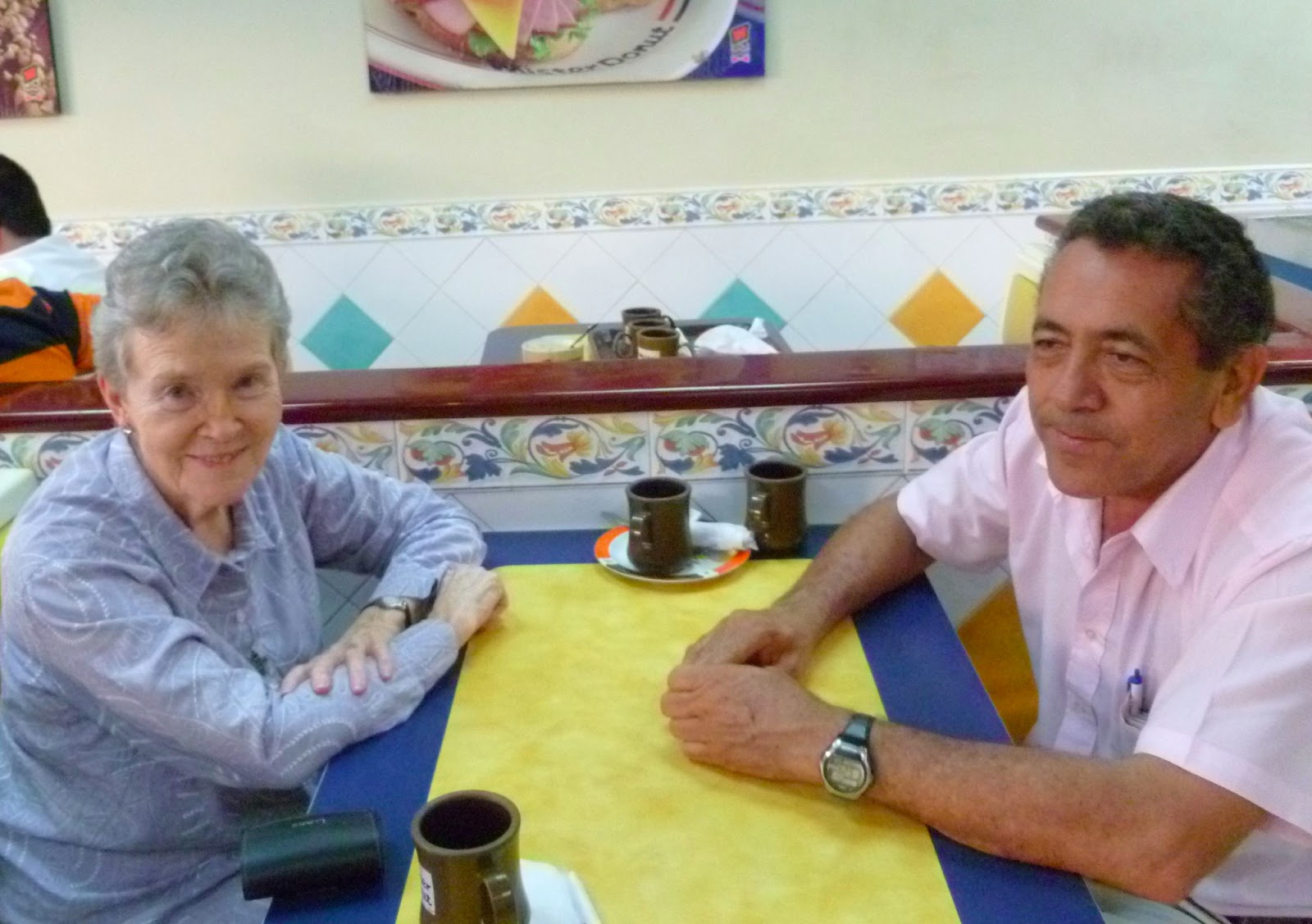
And she went on to a happy reunion in Mr. Donut - always a favorite connecting place - with Lolo Guardado, who has long been helping groups of artesans to sell their work -
And with Hernan Merino, the motorista who keeps us all safe and very happy during many mission trips:
Even here in Suchitoto, Eleanor has had some wonderful days with Peggy O'Neill, and yesterday Moises Alcides Garcia came by. This 20-year-old is about to graduate from a 2 1/2 year Tecnico program in graphic design in the Universidad Andres Bello, and he brought his portfolio to show us the work he's done. Eleanor was remembering eight years ago, when a frail 12-year-old Moises needed two new heart valves and PeaceHealth's Roland Trenouth made sure the replacement valves were purchased so Moises could have his surgery in Hospital Bloom. What great changes in the life and prospects of Moises Alcides!
It's been a grand time, full of memories and hope. Thanks, Eleanor, for sharing this time with me, and for all the many years you have joyfully shared with the people of El Salvador.
We had lunch with Dr. Jorge Cabezas, his wife Betty, and their triplets - Dr. Cabezas is a physiatrist (hope I spelled that right) who designs rehab programs; during Eleanor's time with Jesuit Refugee Services toward the end of the Salvadoran Civil War, he helped many of her patients. Here they are, 24 years later -
Later that day, we visited with Dra. Daysi Ramirez, her husband, Dr. Fredy and their totally enchanting 18-month-old daughter, Ana Valentina:
Then Eleanor caught up with the scholarly pursuits of Walther Jorge Martinez and Alex Hernandez, two PazSalud scholarship students who'd been outstanding volunteers in our clinics:
And she went on to a happy reunion in Mr. Donut - always a favorite connecting place - with Lolo Guardado, who has long been helping groups of artesans to sell their work -
And with Hernan Merino, the motorista who keeps us all safe and very happy during many mission trips:
Even here in Suchitoto, Eleanor has had some wonderful days with Peggy O'Neill, and yesterday Moises Alcides Garcia came by. This 20-year-old is about to graduate from a 2 1/2 year Tecnico program in graphic design in the Universidad Andres Bello, and he brought his portfolio to show us the work he's done. Eleanor was remembering eight years ago, when a frail 12-year-old Moises needed two new heart valves and PeaceHealth's Roland Trenouth made sure the replacement valves were purchased so Moises could have his surgery in Hospital Bloom. What great changes in the life and prospects of Moises Alcides!
It's been a grand time, full of memories and hope. Thanks, Eleanor, for sharing this time with me, and for all the many years you have joyfully shared with the people of El Salvador.
Friday, January 11, 2013
Otra vez, Eleanor in El Salvador
The past week has been filled with joyous reunions, only slightly interrupted by the serious work of getting the paperwork ready for our doctors' permits and our customs clearance.
One joyous reunion has followed another since Sister Eleanor Gilmore walked off the plane last Saturday. Eleanor's long history in El Salvador goes back to time during the civil war in the 1980s, when she worked with the Archdiocese of San Salvador and with Jesuit Refugee Service, was twice picked up for questioning by suspicious authorities, and helped people coming in from the campo, including a few guerillas, get some much-needed health care.
Eleanor left El Salvador after the signing of the peace accords in 1992, but the people had found a place in her heart, and she returned in 2000 to begin the El Salvador Health Mission of PeaceHealth and the Sisters of St. Joseph of Peace. She and Kathy Garcia developed the PazSalud mission over the next nine years as Eleanor continued making friends.
She's stayed away for four years and a few surgeries, but this week she's back at last for a good visit with those friends. We began the celebrations on Sunday with Mass in the Crypt of the Cathedral, where Monseñor Romero is buried, followed by a festival dinner at Estela and Susy Garcia's home, with almost all the Garcia family in attendance. Here's Susy and Estela with Estela's mother and Eleanor- it was a glorious afternoon and wonderful Sopa de Gallina India, la abuela having provided the gallina.
It's been like that all week - we've connected with many, many friends, and each connection has been a delight. I get to share in the memories and in the joy that Eleanor's presence - in El Salvador again! - brings to her and to the many, many folk who know and love her.
Eleanor and I were both saddened that Sister Noreen Linane died while we were so far away. Eleanor says she was ready and completely at peace - it's good to know that, and no surprise. Noreen was a tiny woman full of life and energy who loved gardening and sewing and creating the most beautiful flower arrangements. I first got to know her when, as a novice, I was told to shadow her in her work at Jubilee Women's Center, transitional housing for homeless women in Seattle. As I quickly found out, Noreen's shadow had to move fast and listen hard to the wonderful stream of Irish talk that moved with her - I was exhausted by the day's end, and enchanted. She's continued to be one of the hearts of our community at St. Mary-on-the-Lake, and while she's gone through many serious health crises, she always before has emerged full of energy, ready to move fast, to talk fast and to create beauty. We will miss her so much.
Oh the permissions? I hope all is well....it's always an area of headache and worry until that moment when the customs people wave goodbye to us, and that's still a little more than a month away.
One joyous reunion has followed another since Sister Eleanor Gilmore walked off the plane last Saturday. Eleanor's long history in El Salvador goes back to time during the civil war in the 1980s, when she worked with the Archdiocese of San Salvador and with Jesuit Refugee Service, was twice picked up for questioning by suspicious authorities, and helped people coming in from the campo, including a few guerillas, get some much-needed health care.
Eleanor left El Salvador after the signing of the peace accords in 1992, but the people had found a place in her heart, and she returned in 2000 to begin the El Salvador Health Mission of PeaceHealth and the Sisters of St. Joseph of Peace. She and Kathy Garcia developed the PazSalud mission over the next nine years as Eleanor continued making friends.
She's stayed away for four years and a few surgeries, but this week she's back at last for a good visit with those friends. We began the celebrations on Sunday with Mass in the Crypt of the Cathedral, where Monseñor Romero is buried, followed by a festival dinner at Estela and Susy Garcia's home, with almost all the Garcia family in attendance. Here's Susy and Estela with Estela's mother and Eleanor- it was a glorious afternoon and wonderful Sopa de Gallina India, la abuela having provided the gallina.
It's been like that all week - we've connected with many, many friends, and each connection has been a delight. I get to share in the memories and in the joy that Eleanor's presence - in El Salvador again! - brings to her and to the many, many folk who know and love her.
Eleanor and I were both saddened that Sister Noreen Linane died while we were so far away. Eleanor says she was ready and completely at peace - it's good to know that, and no surprise. Noreen was a tiny woman full of life and energy who loved gardening and sewing and creating the most beautiful flower arrangements. I first got to know her when, as a novice, I was told to shadow her in her work at Jubilee Women's Center, transitional housing for homeless women in Seattle. As I quickly found out, Noreen's shadow had to move fast and listen hard to the wonderful stream of Irish talk that moved with her - I was exhausted by the day's end, and enchanted. She's continued to be one of the hearts of our community at St. Mary-on-the-Lake, and while she's gone through many serious health crises, she always before has emerged full of energy, ready to move fast, to talk fast and to create beauty. We will miss her so much.
Oh the permissions? I hope all is well....it's always an area of headache and worry until that moment when the customs people wave goodbye to us, and that's still a little more than a month away.
Sunday, January 6, 2013
El Último de Doña Licha
My friend Martha's mother died the day after Christmas, after several months of increasingly painful suffering. I think her given name was Maria Louisa, but I knew her as Doña Licha - people here in Suchitoto called her Niña Licha, but I haven't yet managed to get comfortable with addressing a woman of my own age, more or less, as a niña, child. I used to meet Doña Licha in better days when she was on the way to market, and we'd stop and exchange hugs. Martha sometimes brought me tamales her mother had made. And one day, when our medical mission team was visiting Suchitoto, as we do on each mission, Doña Licha came to our house to have her ulcerated leg treated by Dr. Jon Dykstra, a specialist in wound care. Here they are, Doña Licha in blue on the left:
Jon bandaged her leg and gave her some medication for it: the bandage didn't last long, because it was itchy, but the medicated cream was great - soon I was seeing her again on the way to market, and this lasted for several months until she began to suffer from pain in her hips, back, legs and soon everywhere.
The customs of death are very beautiful among Catholic families here. The funeral mass and burial almost always take place the day after the death. Then for eight days the house is transformed into a shrine with flowers and santos and a photo or two, and friends and neighbors and family come by each night to recite the rosary and sing - or just to stand by and be present. On the 9th day, this season of intense mourning closes with a memorial Mass, and then everyone gathers for El Último, the last night of mourning, and some stay with the family all through that night to the next morning.
I was able to join in on one Rosario after I returned from Guatemala and the small house was crammed so full of people that you would not imagine it could hold any more. When Maria del Carmen and I returned for El Último, there were people sitting in rows of chairs in the street outside the house and more people inside. Martha and her sister Orbelina invited us to come in through the side door which usually leads to a yard full of chickens and ducks and dogs and a green parrot. All the animals were elsewhere (I wonder who does the duck-sitting?), the yard was swept and neat, and huge, really HUGE iron bowls of tortillas were waiting. Martha and Orbe and a few friends had worked all morning to make an unimaginable number of tamales, the traditional food served in El Último, and soon we were sitting with tamales and cookies and coffee or hot chocolate. Meanwhile, in the main sala of the house, the singing and prayers continued, as they were to do all through the night.
What a rich religious tradition this is! The rosary is beautifully at the center of these nine days of prayer and mourning, and all around the edges of that murmur of ongoing prayer people share memories and condolences, connect with the family, remember Doña Licha. For over a week the family is held and upheld, even as they work so hard to prepare everything. It may be a relief to come to that 10th day when the house can slowly come back to normal - but as Martha said to me, it will also be very lonely.
Jon bandaged her leg and gave her some medication for it: the bandage didn't last long, because it was itchy, but the medicated cream was great - soon I was seeing her again on the way to market, and this lasted for several months until she began to suffer from pain in her hips, back, legs and soon everywhere.
The customs of death are very beautiful among Catholic families here. The funeral mass and burial almost always take place the day after the death. Then for eight days the house is transformed into a shrine with flowers and santos and a photo or two, and friends and neighbors and family come by each night to recite the rosary and sing - or just to stand by and be present. On the 9th day, this season of intense mourning closes with a memorial Mass, and then everyone gathers for El Último, the last night of mourning, and some stay with the family all through that night to the next morning.
I was able to join in on one Rosario after I returned from Guatemala and the small house was crammed so full of people that you would not imagine it could hold any more. When Maria del Carmen and I returned for El Último, there were people sitting in rows of chairs in the street outside the house and more people inside. Martha and her sister Orbelina invited us to come in through the side door which usually leads to a yard full of chickens and ducks and dogs and a green parrot. All the animals were elsewhere (I wonder who does the duck-sitting?), the yard was swept and neat, and huge, really HUGE iron bowls of tortillas were waiting. Martha and Orbe and a few friends had worked all morning to make an unimaginable number of tamales, the traditional food served in El Último, and soon we were sitting with tamales and cookies and coffee or hot chocolate. Meanwhile, in the main sala of the house, the singing and prayers continued, as they were to do all through the night.
What a rich religious tradition this is! The rosary is beautifully at the center of these nine days of prayer and mourning, and all around the edges of that murmur of ongoing prayer people share memories and condolences, connect with the family, remember Doña Licha. For over a week the family is held and upheld, even as they work so hard to prepare everything. It may be a relief to come to that 10th day when the house can slowly come back to normal - but as Martha said to me, it will also be very lonely.
Subscribe to:
Posts (Atom)