Showing posts with label English. Show all posts

Tuesday, May 8, 2012

Cristóbal

Getting to know Cristóbal has been one of my joys over the last couple of weeks.   He's a 20-year-old from San José Villanueva who showed up at our eye surgery mission one day in hopes of getting some help for his bad eye.  Our ophthalmologists quickly saw retinal damage, and recommended that he see a retinal specialist.  I made an appointment for him with Dr. Solorzano and met him in the doctor's office, which was a challenge to find (it's in an area where one-way streets and diagonals and dead-ends make nonsense of one's rational driving plan).  Once I got there, Cristóbal and I settled into conversation, and I quickly found out that he speaks excellent English.

It's not because he's lived in the states or had native speakers for teachers.  But a visitor from New Hampshire sent him a set of ESL CDs, and he worked and worked with them.  He must have done that work with great determination and great ability, because at this point, halfway through his first year at the University of El Salvador (he's majoring in modern languages, studying English and French as well as his native Spanish) he's very comfortable and skilled in conversational English.

We had a lot of time to speak English together, as Cristóbal had to get his eyes dilated, a process that always takes quite a bit of time, and then we waited for Dr. Solorzano - who turned out also to have excellent English, due to five years in the U.S. specializing in retinal and glaucoma problems.  He quickly diagnosed Cristóbal with a detached retina - but the damage had happened four years ago, and there wasn't much likelihood of recuperating sight in the damaged left eye.  He recommended a laser surgery to prevent any additional damage to the left eye and to insure that the retina in the right eye would not become detached. 

Happily, that meant coming back for the surgery itself, which happened in Dr. S's office,  and another two hours of English conversation with this talented young man (he also plays piano with a local group).  The surgery hurt, which I hadn't expected - Cristóbal had a fierce headache as well as pain in the eyes - so he was quiet as I drove him home.  But we'll connect again when he comes back next week for a checkup, and I look forward to more conversation in my own native tongue.

Cristóbal is one of eight children of a campesino family, the only person in his family who's ever been to a university.  There's neither TV nor a radio in his home, so it's not surprising that the family didn't have the resources to get him help when the retinal detachment happened (I gather he did see one doctor, who recommended glasses).  Dr. Solorzano is now one of my heroes - he waived his fee and charged only for the cost of the laser equipment.  Cristóbal was sad that his vision couldn't be restored - but for someone with his bright future possibilities, it was "vale la pena," worth the trouble, to make sure his other eye stayed good and strong - lots of books in his future, I suspect, and he'll want to enjoy reading them.

Friday, April 9, 2010

Maestra Margarita


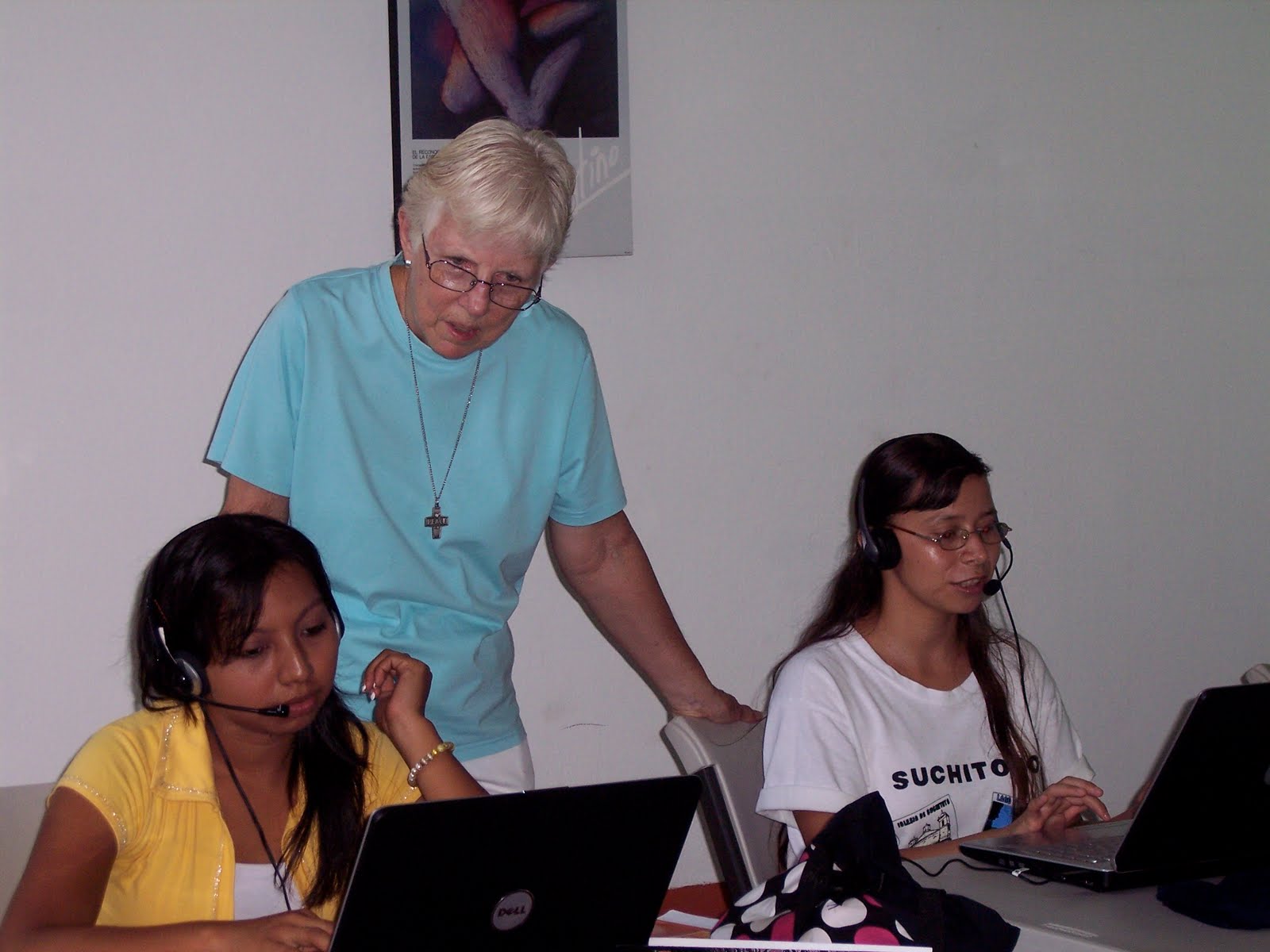
Margaret Jane started her third English class today at the Centro Arte para la Paz - with that addition, she's now teaching on Tuesdays, Wednesdays, Thursdays, Fridays and Saturdays. Each class has three students, young people who need English as teachers, as guides for tourists, and for future work in the University. These have to be the luckiest English students in Central America: with donations from family and friends, Margaret Jane purchased Rosetta Stone programs, workbooks, and games for English learners, and she is always on the lookout for good materials for the classes. Each class includes individual one-on-one conversation with the maestra, computer study, reading aloud, language games and group conversations.

In this photo, Margaret Jane with her two newest students, Sulma and Rosa, both from the Marianella Garcia colonia of Suchitoto. Margaret Jane worked with their parents at the Calle Real Refuge; now she's bringing new energy and hope en inglés to the lives of the daughters.

Friday, December 4, 2009

A rose, by any other name


You discover what's in a name and how complicated names can be when you're looking for a somewhat obscure thing in a language not your own. The other day I was searching for steel wool, something I've used for this and that so many times. I knew better than to translate "steel" and add "wool" - instead I looked it up in two of my English/Spanish dictionaries, and discovered that it's called estropajo de acero which sounded fine. Except that no one in Freund or Vidri, the two largest hardware stores had heard of estropajo de acero. Then I tried to describe it, and talked about a metal sponge, una esponja metálica, and that didn't help either. It also didn't help that my planned use - to discourage rats from colonizing a particular dark corner of the house - got the salesmen talking poisons and traps. I roamed up and down the aisles, trying to spot a little bag of the familiar stuff, and couldn't. Maybe it's never been imported to El Salvador? But that hardly seems likely. Next time I go in, I'm going to take this picture, because a picture is definitely worth 1,000 words. And if I discover what it's called in El Salvador, I'll let you know.

Sunday, August 23, 2009

The students


This is Crisseyda, my computer student and Spanish teacher. She's 11 and lives just down the street in Suchitoto, and she loves learning how to use a computer - in her school, there aren't very many computers and each student just gets a few minutes on one once in a while. So Crisseyda and I have explored the basics - turning the computer on and off, opening a program, writing a few sentences in Word. Right now Crisseyda's learning touch typing (OK, keyboarding, I learned in another era) from a cheerful program, the Ten Thumbs Typing Tutor. It's all been fun to experience with her, and our conversation is very good for my Spanish. We're acquiring a useful vocabulary of computer words in both languages. For me, it's good to be a teacher again - and a learner always.

Wednesday, June 24, 2009

picops and hoosegows

Wonderfully funny things happen when words move from one language to another. I shared one of my favorites, the western U.S. word hoosegow with my teacher Rosa Maria yesterday. She looked at it in puzzlement, and I explained that it was a transliteration into English of juzgado, the Spanish word for a court, though in the West, the jail was the hoosegow, not the court.

I loved finding the word picop in an excellent book I'm reading in Spanish about the murder of Bishop Gerardi, subsequent investigations and the court case (in English, it's The Art of Political Murder by Francisco Goldman). A picop, in case you didn't sound it out, is known as a pickup in the U.S.

Hoosegows and picops - a delightful change from wrestling with the subjunctive and stem-changing verbs.