On Tuesday I was shopping in San Salvador when I got the word that Maria del Carmen had fallen and had a broken leg. Could I come and pick her up in San Martin? When I got there, I learned that she'd gone for a peaceful walk down a dirt road and something - a hole hidden by the drifting sand? a hidden rock? - tripped her, so that she fell badly.
Her friends got her into my car and I took her to the little National Hospital in Suchitoto where a Doctora looked her over and said that yes, the right leg was clearly broken and it looked as if the tendons had been pulled on the left leg. But the X-Ray wasn't available at that hour, and the best she could do was to put a protective covering over the broken leg and to suggest we take her to San Salvador or Cojutepeque.
I was due in to the airport to pick up my friend Judy Stoloff, arriving at 9 pm for a vacation in El Salvador, so Peggy O'Neill most kindly took over, driving Maria del Carmen to the Diagnostic Hospital in San Salvador, where she got x-rays and a light cast on the left leg with the pulled tendons. Surgery or casting of the broken right leg would have to wait until she could get seen at one of the national hospitals.
Peggy got back to Suchitoto with Maria del Carmen a few minutes after I arrived with Judy, and as he'd done throughout the evening, Alcides, a strong and gentle friend, came to carry her to her bed.
The next day Alcides came again to carry her into the car and we drove into San Salvador for a second opinion from Dr. Cabezas, a good friend of Sister Eleanor's and mine, on whether surgery was really necessary. He recommended that she spend the next few days with both legs elevated and that she then get her right leg surgically pinned. He kindly and thoughtfully explained the whole procedure to her, and she said yes, she would do that.
So we bought a bedside commode and returned to Suchitoto (Alcides helping again) where Maria del Carmen has now spent two days in bed with her legs elevated - distracting herself as best she can with books, radio and DVDs. Val Liveoak, a Quaker with the Alternatives to Violence Project, who's also living at the house this month, has helped with nursing - we've all taken turns, and Maria del Carmen does as much as she possibly can for herself. She has a date with the orthopedic surgeon at the Cojutepeque National Hospital (the main hospital for our department) on Tuesday, and we'll hope for an early surgery date.
It's such a shocking thing, to go with one fall from being capable and strong and in control to not being able to walk at all. I have been so struck with Maria del Carmen's spiritual strength which is seeing her through this physical trauma; she is peaceful and cheerful where she could so easily be anxious, fretful. I am glad that Val and Judy and I have all been able to be there for her and have shared the practical nursing.
I think, too, how very differently a fall like this would be treated in our U.S. system - X-Rays and casts and surgery would be instantly available, even in a small town, even for people without financial resources, wheelchairs and walkers or crutches too, I think - though perhaps that's optimistic. Having to wait a week to see an orthopedic surgeon is hard to imagine. But that is normal here - it would have taken even longer to get seen at the main orthopedic hospital in San Salvador, Hospital Zacamil.
Here there's not enough of anything - equipment, doctors, medications, hospital beds - and while the rich can get whatever they need, most Salvadorans have to wait and hope that there will still be care at the end of their waiting. May Maria del Carmen finally receive the care she needs.
Showing posts with label catastrophes. Show all posts
Showing posts with label catastrophes. Show all posts
Thursday, January 31, 2013


Wednesday, November 14, 2012
Falling in holes and getting out of them
I'm back in Suchitoto, back in beautiful summer weather, and my two most faithful blog readers have noted grumpily that I have not been blogging much. True, but I intend reformation, and to prove it, here's a story which probably many car drivers in El Salvador could tell.
Just before my last three weeks in the U.S., I had three consecutive days of driving my car into invisible holes. On the first day, I was visiting Rosita in El Paraiso, and thought I'd drive out of her colonia on the only paved road, for a change (I usually connect to the highway by a dirt road). Sounded like a good idea. Wasn't. There was a depression running the width of the street - possibly caused by runoff - and I went crashing into it because I didn't see it at all. No harm done.
The next day I visited Sonia in San Juan Opico, and was turning off a main road onto the dirt road where she has her little tiendita (Sonia sells knickknacks at her children's school). And there was another hole, also invisible, this one really mean with a pretty good-sized rock at bottom. Extricated myself and discovered that I'd torn a hole in the bottom of the bumper and dislocated the hood from its proper seating. Otherwise, the car was driving normally, so I drove home to Suchitoto.
And on the third day (there's a scriptural ring to that) I was in San Salvador, driving on a perfectly level and beautifully paved street, driving up to the office of CONFRES, the Salvadoran Conference for Religious (Catholic Sisters, Brothers and Fathers) to pay our dues and buy some books - a blameless task. I pulled up to park carefully right in front of their building and whump down went the right front tire into what I discovered (once I got out) was an invisible storm drainage entry, about 2 x 4 feet and at least 4 feet deep, missing its cover. The left rear tire was up in the air, and having 4-wheel drive didn't do a bit of good, though I tried. A nice young man came along, trying to be helpful, and we decided that I should call my insurance company. I was in the middle of the call when a guy rode up on a motorscooter - ah, he said, my friend works at the gas station just down the street, he can come and get you out of this. Great, I said.
While I waited for the friend, I went into CONFRES - might as well do my errand, and I wanted to be sure that they knew they had a car trap in front of their building. Oh yes, said the very helpful Sister at the desk, someone stole the cover. We called ANDA (the water company) but they haven't come. Ah, I said, but couldn't you put a tree in the hole to show people that it's there? (This is the usual way of pointing out perils on the road here - trees, shrubs, big branches stuck in the holes...). We did, she said, but someone took the tree.
I went out again to find my moto friend had returned with his friend who jacked up the car expertly and had me back on the level quickly, for which I paid $23, and glad to pay it. Though it did occur to me to wonder if, just perhaps, one of them was responsible for the disappearance of the drain and then the tree, and they just waited for fools to appear and fall in it...
But fortunately, again, I seemed not to have damaged the essential workings of the car. Today I put it in the care of Chamba, our Suchitoto auto guru, who took it to a guy in Istagua who has replaced the bumper before. Probably a good line of business in El Salvador. He's replacing the bumper again, doing physical therapy on the hood, and realigning - and I think there were some other bits needing to be fixed that were past my Spanish car talk level. It will cost me $160. There are some very wonderful things about living here, and, as usual, they more than compensate for the invisible holes.
Just before my last three weeks in the U.S., I had three consecutive days of driving my car into invisible holes. On the first day, I was visiting Rosita in El Paraiso, and thought I'd drive out of her colonia on the only paved road, for a change (I usually connect to the highway by a dirt road). Sounded like a good idea. Wasn't. There was a depression running the width of the street - possibly caused by runoff - and I went crashing into it because I didn't see it at all. No harm done.
The next day I visited Sonia in San Juan Opico, and was turning off a main road onto the dirt road where she has her little tiendita (Sonia sells knickknacks at her children's school). And there was another hole, also invisible, this one really mean with a pretty good-sized rock at bottom. Extricated myself and discovered that I'd torn a hole in the bottom of the bumper and dislocated the hood from its proper seating. Otherwise, the car was driving normally, so I drove home to Suchitoto.
And on the third day (there's a scriptural ring to that) I was in San Salvador, driving on a perfectly level and beautifully paved street, driving up to the office of CONFRES, the Salvadoran Conference for Religious (Catholic Sisters, Brothers and Fathers) to pay our dues and buy some books - a blameless task. I pulled up to park carefully right in front of their building and whump down went the right front tire into what I discovered (once I got out) was an invisible storm drainage entry, about 2 x 4 feet and at least 4 feet deep, missing its cover. The left rear tire was up in the air, and having 4-wheel drive didn't do a bit of good, though I tried. A nice young man came along, trying to be helpful, and we decided that I should call my insurance company. I was in the middle of the call when a guy rode up on a motorscooter - ah, he said, my friend works at the gas station just down the street, he can come and get you out of this. Great, I said.
While I waited for the friend, I went into CONFRES - might as well do my errand, and I wanted to be sure that they knew they had a car trap in front of their building. Oh yes, said the very helpful Sister at the desk, someone stole the cover. We called ANDA (the water company) but they haven't come. Ah, I said, but couldn't you put a tree in the hole to show people that it's there? (This is the usual way of pointing out perils on the road here - trees, shrubs, big branches stuck in the holes...). We did, she said, but someone took the tree.
I went out again to find my moto friend had returned with his friend who jacked up the car expertly and had me back on the level quickly, for which I paid $23, and glad to pay it. Though it did occur to me to wonder if, just perhaps, one of them was responsible for the disappearance of the drain and then the tree, and they just waited for fools to appear and fall in it...
But fortunately, again, I seemed not to have damaged the essential workings of the car. Today I put it in the care of Chamba, our Suchitoto auto guru, who took it to a guy in Istagua who has replaced the bumper before. Probably a good line of business in El Salvador. He's replacing the bumper again, doing physical therapy on the hood, and realigning - and I think there were some other bits needing to be fixed that were past my Spanish car talk level. It will cost me $160. There are some very wonderful things about living here, and, as usual, they more than compensate for the invisible holes.
Monday, October 15, 2012
Bureaucratic tangles

Darren and I came out of a meeting at the Ministry of Health - I'd been pleased to find a place to park my car right in front of the building - to find a ticket on the windshield. I saw that I'd parked by a yellow-painted curb, and down at the other end of the block was a small sign saying that parking was only available for official cars. Ooops. It had been raining and the ticket was soaked, so we put it to dry on the back seat. A couple of stops later we noticed that the car no longer had license plates. Our first and natural assumption was that they'd been stolen - a good possibility, as the Ministry of Health is in the historic center of town where thieves are said to abound. Darren called a lawyer friend to ask how we should report this crime, and the lawyer asked if by chance we'd gotten a ticket. Well.....yes. And when we looked more closely, we discovered that the ticket - which was listing this parking mishap as the heaviest possible level of transportation crime and assessing a fine of $54, astronomical in Salvadoran terms - had a little checkmark noting that the plates had been removed.
So we called Darren's lawyer friend again and he sent us to an office of the transportation police. When we got there, the guard at the gate refused to even let us enter; instead, he gave me a one-page paper telling me that I couldn't pay the fine and get my plates back for 24 hours. I drove back to Suchitoto hoping I wouldn't have to explain myself, and then back into the capital the next day, 24 hours later, to pay the fine. In Sertracen (where one pays fines and renews licenses) they happily took my $54 and told me to go around the building to the Vice-Ministry of Transportation Office to collect my license plates. When I got there, the officials on hand looked at my paperwork and looked at their files and informed me that my plates were....somewhere else. I would have to come back the next day.
And so I drove back to Suchitoto (this time at least I had paperwork to show I'd paid the fine, and a good thing too, as finally the police did stop me to ask why I was driving with no license plates) and back to Sertracen the next morning where I finally got the plates, but not the nuts and bolts that had held them on the car - those had apparently been discarded on site, or in someone's pocket. I'm still trying to figure out why parking in a forbidden parking space is a crime more heinous than speeding (ticket of about $15 if I remember correctly, and no tinkering with the license plates) or any of the other really dangerous tricks that Salvadoran motorists get up to daily.
That same day, after retrieving my plates, I went to the Migration office where I'd paid for my year's Residence Visa in January, but had yet to receive it. I've had to purchase two 3-month temporary visas so I could leave and re-enter the country. But the best moment in this particular bureaucratic hell was in August when the office called me to come in, and told me that I had to get a letter from the embassy to say that I am really who I say I am because the version of my name was slightly (very, very, very slightly) different in my birth certificate, my police check, and my passport. Never mind that all three showed the exact same place and date of birth and that the difference was between Susan Vera Dewitt, Susan Vera De Witt, and Susan V. Dewitt. Not only did I have to go to the embassy for a letter ("we see this all the time," they said, tiredly), I had to pay to have Salvadoran staff in a special little office not far from the embassy to put an apostille on my letter from the embassy to certify that it was genuine. I had, of course, to pay for that, which may well have been the point.
This time, in October, I didn't get past the front desk of the Migration office. The receptionist kindly informed me that my card wasn't ready, and probably wouldn't be, and they were changing the whole process somehow, and things would be different next year, but meantime...meantime....
And then I went home, asked Alcides to attach my license plates, and tried very hard to stay peaceful.
Thursday, March 15, 2012
Travelogue with complications
Today began and ended splendidly. The middle was questionable.

 Rose
Young and Donna Quaife, (that's Donna in the rocking chair and Patti
Moore and Rose with me in the dining room) both
of them sterling members of our 2011 medical mission in San Rafael
Cedros, are visiting our Base House here in Suchitoto for a couple of
days, and we began the morning happily with pancakes, bacon, and a good
long walk down to Lago Suchitlan - about 2 miles, but all downhill. Had
a coke, enjoyed the breezes, took the little shuttle bus back UP to
Suchitoto Centro. Back at the house, we connected with Patti Moore,
who'd been studying Spanish while we larked, and made lunch from last
night's arroz con pollo - a Rose and Susan joint project - with avocado, tomato and watermelon on the side.
Rose
Young and Donna Quaife, (that's Donna in the rocking chair and Patti
Moore and Rose with me in the dining room) both
of them sterling members of our 2011 medical mission in San Rafael
Cedros, are visiting our Base House here in Suchitoto for a couple of
days, and we began the morning happily with pancakes, bacon, and a good
long walk down to Lago Suchitlan - about 2 miles, but all downhill. Had
a coke, enjoyed the breezes, took the little shuttle bus back UP to
Suchitoto Centro. Back at the house, we connected with Patti Moore,
who'd been studying Spanish while we larked, and made lunch from last
night's arroz con pollo - a Rose and Susan joint project - with avocado, tomato and watermelon on the side.
 Then
we all hopped in the car for a visit to Ilobasco and San Sebastian, two
towns famous for their crafts. I decided it would be fun to go via
Cinquera, the next town to the east of Suchitoto, knowing that it would
be a slow, but scenic, dirt road. Slow it was, scenic it was
(especially watching cattle crossing this river), and somewhere after
Cinquera a bug announced that it had gotten into my digestive tract and
wanted to get out PRONTO. Never before have I had to find a pooping
place along the side of the road, but alas, that was necessary. I don't
think too many cars passed and I hope none of them were from
Suchitoto. Ten minutes later, another urgent call - this time we were
in a small town, and I pulled over and dashed into a little government
office, which - thank you, God - had a very helpful guard and the
cleanest bathroom I've ever seen. Ten minutes later we pulled into
Ilobasco and my final port of call in a Pollo Compero (another kindly
guard - I must have looked as desperate as I felt). And then the bug
was gone. I did hobble over to the nearest pharmacy for a Cipro, but
I'm pretty sure I didn't really need it.
Then
we all hopped in the car for a visit to Ilobasco and San Sebastian, two
towns famous for their crafts. I decided it would be fun to go via
Cinquera, the next town to the east of Suchitoto, knowing that it would
be a slow, but scenic, dirt road. Slow it was, scenic it was
(especially watching cattle crossing this river), and somewhere after
Cinquera a bug announced that it had gotten into my digestive tract and
wanted to get out PRONTO. Never before have I had to find a pooping
place along the side of the road, but alas, that was necessary. I don't
think too many cars passed and I hope none of them were from
Suchitoto. Ten minutes later, another urgent call - this time we were
in a small town, and I pulled over and dashed into a little government
office, which - thank you, God - had a very helpful guard and the
cleanest bathroom I've ever seen. Ten minutes later we pulled into
Ilobasco and my final port of call in a Pollo Compero (another kindly
guard - I must have looked as desperate as I felt). And then the bug
was gone. I did hobble over to the nearest pharmacy for a Cipro, but
I'm pretty sure I didn't really need it.
 And
so we all went on - my three most understanding and helpful friends who
were only laughing a little and my recovered self - to the Moje shop where we had a great time (Moje is an organization that gives
crafts training and employment to youth who would otherwise be likely
candidates for gang membership - they sell beautiful crafts in clay and wood). And we went on to San Sebastian,
famous for its weavers, where we visited Nohemy's shop and watched one
of the weavers at his hard and demanding and beautiful work.
And
so we all went on - my three most understanding and helpful friends who
were only laughing a little and my recovered self - to the Moje shop where we had a great time (Moje is an organization that gives
crafts training and employment to youth who would otherwise be likely
candidates for gang membership - they sell beautiful crafts in clay and wood). And we went on to San Sebastian,
famous for its weavers, where we visited Nohemy's shop and watched one
of the weavers at his hard and demanding and beautiful work.
We drove happily back to Suchitoto (all on paved highway this time) with purchases and photos, headed to La Balanza for pupusas and Salvadoran enchiladas - a great, full day, and somehow even catastrophes are not so bad when you share them with friends.
Photos by Rose Young


We drove happily back to Suchitoto (all on paved highway this time) with purchases and photos, headed to La Balanza for pupusas and Salvadoran enchiladas - a great, full day, and somehow even catastrophes are not so bad when you share them with friends.
Photos by Rose Young
Friday, January 6, 2012
Feliz Año and all that jazz
It's a bit of a shock to find I haven't posted since New Year's Eve. But mind you, the silence has only been on the blog channel. Andrea and Judith and I have been having a wonderful time, first in Antigua, and then in El Salvador, where we visited our February medical mission site in San José Villanueva and last year's site, San Rafael Cedros. There we had lunch with Mari and her family and enjoyed Richard Stanley looking healthy and happy with his new heart valve working just as it should - and Judith got to see one of our water filters in use. This was especially nice, because she's donated quite a few of them to PazSalud.
But yesterday was the best, though not at all what we had planned. We had planned going to visit Nuestros Pequeños Hermanos, a home for orphaned and abandoned children that's north of Santa Ana, a fairly long drive from Suchitoto. We set out, and five minutes later the car announced that it was shutting down - check engine light on, engine coughing, and - we quickly discovered - the temperature up at the ceiling. We called Peggy, who sent out her friend and car doctor Chamba; Chamba arrived in a pickup, put some water in the radiator which promptly began dripping out again which led to a diagnosis. He refilled the radiator and drove the X-Trail back into a taller (repair shop) in Suchi, and we followed behind in his pickup, driven by a young friend. Riding in the back of the pickup was a great treat for Judith, after she'd seen so many Salvadorans in one.
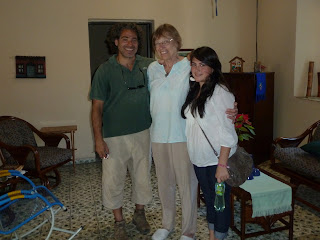
There we were at home when Peggy called to say she had a special friend of Andrea's who'd just popped in for a visit. She sent him over, and it was the famous John Guiliano, who'd worked as a volunteer at Calle Real with Andrea and Margaret Jane during the Civil War, decided to stay in El Salvador, married, settled in Guajila, Chalatenango, and is working to engage the young folk of that community in sports. I'd heard so much about him, and he lived up to billing: joyful, dramatic, very Italian, determined and great fun. We also got to meet his beautiful 15-year-old daughter Rose, and we all went out to lunch at the Café Guazapa and listened to the stories. Imagine, if the car hadn't had a breakdown, John would have missed seeing Andrea for the first time in about 25 years.
I was glad, too, because the day at home gave me time to assemble all the materials that I needed to present today for our customs approval - there were three separate packets, lots of paper, lots of details to worry about, and I needed the time. And today, oh joy, I got each packet into the right office with the right people there to receive it. Primero Dios, we'll get our franquicia in plenty of time this time... And in any case, gracias a Dios for getting to meet John and share a memorable lunch. Oh, and the car repair was well done, we've driven all day today with no trouble. Gracias tambien a Chamba.
But yesterday was the best, though not at all what we had planned. We had planned going to visit Nuestros Pequeños Hermanos, a home for orphaned and abandoned children that's north of Santa Ana, a fairly long drive from Suchitoto. We set out, and five minutes later the car announced that it was shutting down - check engine light on, engine coughing, and - we quickly discovered - the temperature up at the ceiling. We called Peggy, who sent out her friend and car doctor Chamba; Chamba arrived in a pickup, put some water in the radiator which promptly began dripping out again which led to a diagnosis. He refilled the radiator and drove the X-Trail back into a taller (repair shop) in Suchi, and we followed behind in his pickup, driven by a young friend. Riding in the back of the pickup was a great treat for Judith, after she'd seen so many Salvadorans in one.

There we were at home when Peggy called to say she had a special friend of Andrea's who'd just popped in for a visit. She sent him over, and it was the famous John Guiliano, who'd worked as a volunteer at Calle Real with Andrea and Margaret Jane during the Civil War, decided to stay in El Salvador, married, settled in Guajila, Chalatenango, and is working to engage the young folk of that community in sports. I'd heard so much about him, and he lived up to billing: joyful, dramatic, very Italian, determined and great fun. We also got to meet his beautiful 15-year-old daughter Rose, and we all went out to lunch at the Café Guazapa and listened to the stories. Imagine, if the car hadn't had a breakdown, John would have missed seeing Andrea for the first time in about 25 years.
I was glad, too, because the day at home gave me time to assemble all the materials that I needed to present today for our customs approval - there were three separate packets, lots of paper, lots of details to worry about, and I needed the time. And today, oh joy, I got each packet into the right office with the right people there to receive it. Primero Dios, we'll get our franquicia in plenty of time this time... And in any case, gracias a Dios for getting to meet John and share a memorable lunch. Oh, and the car repair was well done, we've driven all day today with no trouble. Gracias tambien a Chamba.
Wednesday, April 6, 2011
Prayer partner

When I'm here in the Northwest, I have a room at St. Mary-on-the-Lake, well stocked with my fall-winter-spring clothes and a lot of books and pictures. In the mornings I pray, looking out at my prayer partner, a beautiful western red cedar that sits just outside my room's big window. There's something about the red cedar's combination of strength and gracefulness that makes me rejoice.
I think my prayer partner was watching out for me yesterday. I've been having some tests to figure out the cause for shortness of breath and wheezing I've been experiencing over the past few months, beyond my ordinary level of asthma. Yesterday I was in Swedish Hospital in Seattle for a bronchoscopy under general anesthesia. Came home about 1 pm, had a good afternoon nap, got up still a bit wobbly, and managed to trip, probably over my own feet, and hit my head on the edge of the sink counter, tearing a triangular flap on the top of my head. Like all head wounds it bled dramatically. Luckily Sister Eleanor was just down the hall, and took me down to the ER of Overlake Hospital in Bellevue - where I managed a twofer, getting my head stitched up and a breathing treatment at the same time (lungs feeling tormented, I don't doubt). Could have been much worse. But 10 hours in two hospitals - more than enough for one day!
So this morning I looked out again at my tree waving its gentle green branches in my direction. And I said to the tree, primero Dios, God first. And the tree whispered primero Dios back to me. Glad to have breath and to give breath back.
Sunday, January 16, 2011
A rougher night

Last night I woke up at about 11:30 - the music was still booming over from the disco next door, but I seem to have learned how to sleep through it - and walked down to the bathroom, which is outside in the patio. Sudden stabbing pain in my heel. There outside the bathroom door I had managed to step on an alacran - that's the name for the local scorpion - and it had stung me. I yelped and carried on enough to wake up Margaret Jane (Korla was out at a local festival) who sat down with me at the kitchen table while we checked out Donde No Hay Doctor (Where There Is No Doctor), the invaluable first aid / health education manual. Alacran venom varies a lot in strength, but it's rarely dangerous for adults. That was the good news, but on the other hand, the pain and swelling can last for weeks or months...
I was beginning to feel altogether strange. My mouth started buzzing, then fingers, arms and legs. Korla got back, and told us that a Salvadoran friend had said to cut off the stinger, soak it in alcohol, and apply that to the wound. We'd killed the alacran by then, so why not? Soaked the stinger in a bit of the very nice brandy my Christmas guests had left and bathed my heel. I stumbled off to bed and spent the next five hours in chills and sweating, staggering when I tried to walk, my skin buzzing with electricity. My body felt light, unfamiliar, unsettled. This had definitely been an alacran which, in spite of being only about 3 inches long, had plenty of strong venom.
Now, twelve hours later, the buzz is still with me, but is lessening. My heel doesn't hurt at all, which suggests that the brandy soak was a good idea. I will definitely be putting shoes on in the future when I head to the bathroom in the dark, and I'll probably carry a flashlight with me for a while. I'm just mostly grateful that the alacran got me, and not Kathy Garcia, who is about half my size and would have had an even worse time with the venom.
I'd like to settle down now for 24 hours of uneventful peace, quiet and recuperation with no wildlife attached.
Thursday, November 12, 2009
Delivering the beans and rice

I've never had quite so much fun in PriceSmart (the El Salvador equivalent of Costco) - Pat and I went up and down the aisles, loading up three huge shopping carts with purified water, diapers and the basics - beans, rice, cornmeal, oil. Margaret Jane was cheering us on from her Spanish class in Suchitoto. All the purchases just barely fit into our old Toyota 4-runner. Then we delivered them to the Archdiocese, and these great guys unloaded the goods and took them to the storeroom where Dina, Margarita and Clelia from the Caritas-Pastoral Social office were sorting donations. They'll know where to put all those beans to best use.
Thanks to the Sisters of St. Joseph of Peace and PeaceHealth for making this donation possible. I just wish it wasn't necessary: there are too many people homeless and grieving tonight in El Salvador. International aid has begun to arrive and the government is trying to respond to the needs that extend all the way from beans and rice and diapers for tonight to bridges and houses to rebuild over the next many months. To add to all these troubles, the enormous rainfall and flooding destroyed many crops, particularly the beans that were just being harvested and the second harvest of corn, so the prices of those staples are going to climb in the next few months. It's more than people here, already fragile, already stressed, can bear.
In time of need
Yesterday we asked Dina Duvon de Garcia, long-time friend of the Sisters of St. Joseph of Peace and one of the Caritas staff at the Archdiocese, how we could help in this time of emergency (there are 14,000+ people in emergency shelters all over central El Salvador at the moment). Today we got an answer: buy basic foods and clean water and diapers and deliver them to the Archdiocese. So we are off on this mission of mercy: we'll use funds from the Sisters and from PeaceHealth to fill the car. It feels wonderful to be delivering some concrete assistance!
Monday, November 9, 2009
Storm and flooding damage many

A tremendous rainstorm and damaging floods caused great damage in central El Salvador Sunday morning. There was a huge rainstorm, caused by a low-pressure system linked indirectly to Hurricane Ida, that stalled over El Salvador and let loose an unbelievable amount of water - President Funes said that San Vicente, the community worst hit, had as much rain in four hours as had fallen in four days during Hurricane Mitch. There were terrible floods and landslides, many people were killed (at present more than 130 are reported killed, with 90 people listed as missing) and others are now homeless. The photo above is from La Prensa Grafica
We are all fine in Suchitoto and there was no damage to our house or to the Centro Arte para la Paz, but the nearby city of San Martin was hard hit. I was in Morazan for the weekend with my friend Pat & we waited over until today (Monday) because so many roads were closed. As we came home today, we saw lots of damage - collapsed houses, giant flood plains, trees toppled, rocks and earth spilling out onto the highway. When we got back to Suchitoto, Margaret Jane and Pat and I put together a couple of big piles of towels and sheets and clothing and took them down to the Mayor's office here to help those who are left homeless.
If any of you would like to help, a cash donation will help relief organizations provide the supplies and food and medicine so badly needed. Organizations doing good relief work include:
If any of you would like to help, a cash donation will help relief organizations provide the supplies and food and medicine so badly needed. Organizations doing good relief work include:
For links to other reports, photos, and maps, go to Tim's El Salvador Blog, always an excellent source of up-to-date information here.
It has been very sad to see on television the faces of those who've lost family memebers or houses and all their possessions. As you can imagine, and as is always the case here, it has hit the poor communities hardest.
Sunday, August 30, 2009
An alarming day
Last night the lights went out for about six hours during a thunderstorm, and Margaret Jane, Kathy Garcia, Ken Henderson and I crept around with candles and flashlights. This morning, with the lights restored, there was a knock on the door, and there was Hernan Merino, whose coaster has been the transportation for almost all of our mission groups. We were heading to the airport, and he was taking a group of Spaniards to the airport about an hour later. We had a great visit, then Margaret Jane and I got in the car to take Kathy and Ken to the airport. As we were driving out of Suchitoto, the security system malfunctioned, and the car stopped, howling about how it was being stolen. A little work, trial and error and waiting until the howling stopped, and we managed to get it started again.
Half an hour down the road, we came to San Martin, and found the usual path to the Carretera de Oro (the golden highway, so called because of its high cost) blocked by a parade and fiesta - and slowly, very, very slowly, made it through a number of unmarked detours to the highway. I may have pushed the speed limit a bit from there, so we arrived at the airport in good time for their flight.
And then, as we were driving out of the airport, it happened again. The button that's supposed to disarm the car alarm wasn't functioning. The car hooted, beeped, and when all my button pushing didn't connect, it stopped on the exit from the airport and howled and went dead and refused to start again. We tried everything, and nothing worked. The airport police came to see what was the matter, and came back with a policeman who they said was really good at these things. He tried. Nothing. A nice man stopped his car to help us. Nothing. We called Hernan, who was just leaving his group at the airport, and he parked his coaster behind the Toyota and tried everything he could think of. Nothing. Finally he called his brother who suggested calling a locksmith, and the locksmith came dashing down from Mejicanos (a San Salvador suburb), and dismantled the alarm. Should he just take it all out? he asked - Oh yes, I said, please get rid of it. So he did, as Margaret Jane and Hernan and I shared water and the shade of the trees. And after about 3 hours on the side of the airport road, we finally were able to start the drive back to Suchitoto.
What was grand in all this was the helpfulness that I've learned is so easily found in El Salvador - and the police and the man who stopped and Hernan and the mechanic all played a part in putting us back on the road again, this time with a voiceless car.
Half an hour down the road, we came to San Martin, and found the usual path to the Carretera de Oro (the golden highway, so called because of its high cost) blocked by a parade and fiesta - and slowly, very, very slowly, made it through a number of unmarked detours to the highway. I may have pushed the speed limit a bit from there, so we arrived at the airport in good time for their flight.
And then, as we were driving out of the airport, it happened again. The button that's supposed to disarm the car alarm wasn't functioning. The car hooted, beeped, and when all my button pushing didn't connect, it stopped on the exit from the airport and howled and went dead and refused to start again. We tried everything, and nothing worked. The airport police came to see what was the matter, and came back with a policeman who they said was really good at these things. He tried. Nothing. A nice man stopped his car to help us. Nothing. We called Hernan, who was just leaving his group at the airport, and he parked his coaster behind the Toyota and tried everything he could think of. Nothing. Finally he called his brother who suggested calling a locksmith, and the locksmith came dashing down from Mejicanos (a San Salvador suburb), and dismantled the alarm. Should he just take it all out? he asked - Oh yes, I said, please get rid of it. So he did, as Margaret Jane and Hernan and I shared water and the shade of the trees. And after about 3 hours on the side of the airport road, we finally were able to start the drive back to Suchitoto.
What was grand in all this was the helpfulness that I've learned is so easily found in El Salvador - and the police and the man who stopped and Hernan and the mechanic all played a part in putting us back on the road again, this time with a voiceless car.
Sunday, July 19, 2009
Welcome, Margaret Jane!
t
Yesterday I very happily drove to the airport to pick up Sister Margaret Jane Kling, who is joining me in Suchitoto to create a CSJP community. El Salvador is familiar ground to Margaret Jane, who ministered here in refugee camps and urban communities for five years during the Salvadoran Civil War. She's been back several times since, but this time she's here to stay for awhile, and I couldn't be happier! Patti Moore kindly took this photo of us relaxing in the patio.
Our return had a little extra drama to it: on the way back, I got a call from Patti, telling me that Marta had fallen off the stepladder and hurt her ankle. She had been trying to do some touch-up painting to cover the handmarks left by the electricians; instead Marta and the ladder and the paint all ended up on the floor together. Patti discovered that 911 doesn't work in Suchitoto, and since her Spanish is very limited, managed to find my cell phone number. I called Peggy O'Neill and Peggy got Marta in touch with her sister Orbelina and we hurried back. When we got to the house, we found Patti and Orbelina hard at work cleaning paint off the floor and Marta sitting with ice on her swollen ankle. A trip to the Suchitoto hospital for an X-Ray revealed that - thankfully - this was a sprain, not a break, so now Marta is back home recuperating and the handmarks are still on the wall.
Then I cooked dinner for Margaret Jane and Patti and Peggy O'Neill, and I have to say, as someone who thinks she's a good cook, it was the worst dinner I've ever put together - the steak was as tough as young shoe leather, the rice was soggy, the broccoli got overcooked. Only the salsa, which Patti made, and the watermelon, prepared by God, saved the meal. But everyone ate and was happy....sometimes it's enough just to be with friends.

Yesterday I very happily drove to the airport to pick up Sister Margaret Jane Kling, who is joining me in Suchitoto to create a CSJP community. El Salvador is familiar ground to Margaret Jane, who ministered here in refugee camps and urban communities for five years during the Salvadoran Civil War. She's been back several times since, but this time she's here to stay for awhile, and I couldn't be happier! Patti Moore kindly took this photo of us relaxing in the patio.
Our return had a little extra drama to it: on the way back, I got a call from Patti, telling me that Marta had fallen off the stepladder and hurt her ankle. She had been trying to do some touch-up painting to cover the handmarks left by the electricians; instead Marta and the ladder and the paint all ended up on the floor together. Patti discovered that 911 doesn't work in Suchitoto, and since her Spanish is very limited, managed to find my cell phone number. I called Peggy O'Neill and Peggy got Marta in touch with her sister Orbelina and we hurried back. When we got to the house, we found Patti and Orbelina hard at work cleaning paint off the floor and Marta sitting with ice on her swollen ankle. A trip to the Suchitoto hospital for an X-Ray revealed that - thankfully - this was a sprain, not a break, so now Marta is back home recuperating and the handmarks are still on the wall.
Then I cooked dinner for Margaret Jane and Patti and Peggy O'Neill, and I have to say, as someone who thinks she's a good cook, it was the worst dinner I've ever put together - the steak was as tough as young shoe leather, the rice was soggy, the broccoli got overcooked. Only the salsa, which Patti made, and the watermelon, prepared by God, saved the meal. But everyone ate and was happy....sometimes it's enough just to be with friends.
Saturday, June 20, 2009
Mercados and minor disasters

Here's a bit of the beauty and abundance of the market in Antigua, which goes on and on for blocks. Rosa Maria, my teacher, took me over to the market for atole blanco (a hot and salty corn drink made with white cornmeal and black beans) and tamales. Delicious! I'm also enjoying the food at Doña Thelma's house - she is a wonderful cook, and has made many local specialties while I've been there. Lunch, almuerzo, is the main meal of the day here, as it is in El Salvador. Breakfast and supper are both accompanied by a plate with a large fresh roll and a big leaf-shaped cookie, called an hoja (leaf), perfect for dipping into tea or coffee. I have probably gained a pound or two, because the hojas are very hard to resist.
My minor disaster was what must be a typical accident here. I walked out of an internet café and walked on down the sidewalk, thinking over something or other, and WHAM, walked right into one of the projecting stone window sills that stick out into the sidewalks all over Antigua. I soon noticed that blood was dripping down from my forehead and concluded that I had a little head wound. As you may know, nothing bleeds like a head wound! I walked toward my house looking like the survivor of a violent attack. A couple of very nice men insisted on giving me a ride, and when I got back to the house, Don Carlos, Thelma's husband, provided cotton and iodine. A brief headache, well deserved, but after a couple of hours I was back to normal, promising to pay CAREFUL attention to my surroundings. The next day, on my way to school, as I was scanning the horizon for window sills to avoid I managed to step into a fresh heap of dog poop. Sometimes you just can't win.
Sunday, April 19, 2009
Baptism by fire

Saturday Hernan and I set off for the airport in Hernan's beautiful red coaster with an operating microscope and stand, a slit lamp (don't ask me what it does!), an autoclave (sterilizer), and boxes full of sterilized water, scrub soap, and snacks. We were on our way to pick up our crew of 8 for the coming week of cataract surgeries, and I got so preoccupied with all the preparations that I forgot to check the plane status. Folly! When we got to the airport, we soon found that the plane (normally due at 7:45 PM) had been delayed and was now scheduled for 11 PM. We settled down to wait, which is such an ongoing part of life in El Salvador, and I checked in with the airport authority police from time to time about whether and when they would let me go in to meet our passengers (and their baggage). I waved my set of franquisia papers around a lot - these allow us to import the medications we were bringing in without paying any customs duty, and I was of the opinion that it was going to make it easy to get our equipment and medications through customs. I was wrong.
The plane finally did arrive - at about 1 AM - and our group assembled at the customs line. I waved my franquisia again, and the customs agent started going through it with a fine tooth comb. He looked through the list, written in English (and already approved by the body that approves medicine imports), and wanted to know the translation for every term. Charo Sanchez from Bellingham, our interpreter for this mission, gamely went through the list as he made notes. Then he started looking up the medications on his computer. Then he told us that because we were bringing in anesthetics (the local anesthetics used to numb the eye for surgery), our import would have to be approved by the anti-narcotic division, but they were not at the airport at this hour (by now it was 2:30 AM), and furthermore the import would have to be approved by the anti-narcotics division chemist, and he only worked Monday through Friday, but maybe he would come in tomorrow to take a look at our anesthetics.
OK, we said, gritting our teeth (much toothgrinding going on), OK, keep the medications and we'll come back for them tomorrow, but let us take the rest of the things we need to have tomorrow to set up the operating room - the scrubs and patient gowns and sutures and eye patches and sterile gloves, and so on. No, he said, it's all on the one franquisia, so nothing in the whole shipment can be taken until it all has been approved.
We were a shell-shocked and completely exhausted bunch by now and it was clear that nothing was going to budge our customs agent, so we climbed wearily into Hernan's bus and went to the Hotel Novo, where a very sleepy looking night clerk let the group in at 3:30. I went back home and slept (blissfully) for four short hours.
We had managed to come away with a phone number and name to call the next day. When Charo called she talked to someone who said oh yes, no problem, everything's approved, come on down and get it. So Charo and Dra. Silvia Pleitez and I climbed on to Hernan's bus and rode down to the airport. The woman Charo had talked to said we didn't need to go to the Port Authority police to get permission to enter the Customs area - but we did. Another lengthy set of explanations, and we were back in customs, and the same customs agent was there, glumly filling out yet more forms. Can we pick the boxes up now? we said. It's going to be another 20 minutes, they said. Finally, after a half hour that felt like eternity, they had Charo sign her name on about 15 different pieces of paper, and they turned loose our equipment, and we loaded it into the bus and headed back to San Salvador.
Finally, today, we did get to the hospital, we did set up the surgery suite, we are ready for patients tomorrow - but I hope never to go through anything quite like the last 48 hours again. You can probably see the accumulated strain in the tired face of Charo, sitting on the right next to Silvia in the photo above. Behind them are the liberated boxes and duffel bags and tubes, taking up more than half of the coaster. Behind us, for this time anyway, is the customs office.
Monday, March 2, 2009
Up the road to Comasagua

I drove up to Comasagua today to meet with Mercedes Arias, the community organizer for CIS who coordinated our medical mission. We went over the list of those who were screened for cataract surgery and planned hiring a bus to take each day's patients in to San Rafael Hospital in Santa Tecla. It's great to work in an organized community - between the CIS organizers and students and the health promoters in the Unidad de Salud clinic, we have really great connections with our patients in their smaller communities.
We walked up to the Unidad de Salud and it was wonderful to see so many familiar faces - Alex, the world's best pharmacy volunteer; Gloria, the clinic pharmacist; Mauricio, who keeps the physical plant in order; and Doctora de Larios, who opened the clinic to us and managed the referrals for patients who needed to be seen at the hospital. There were some people waiting to be seen, but nothing like our crowds. And the water is running again!
Mercedes asked for a ride down to Santa Tecla, and on the way we talked about the earthquake of 2001, which destroyed every house and building in Comasagua. Mercedes and her husband and children lived in a tent for more than a year, until her husband managed to build a very small house, which they are still enlarging and arranging. Much of today's Comasagua, especially the public buildings - the San Mateo church, above, the Alcaldia, the Unidad de Salud, and the Casa Comunal - were built by Venezuelan soldiers. They also rebuilt some houses, but the Salvadoran government decided it was time for them to return home - before they got to Mercedes' house.
Sunday, March 1, 2009
Me caí
One of the areas where Spanish is a lot more subtle than English is the reflexive which - forgive me, I'm no linguist - takes the responsibility out of the hands of the speaker and puts it on those stubborn things that trip us up. Literally, in this case. Me caí means I tumbled - but with the shading "I was tumbled." And was I ever tumbled.
The house has a winding staircase, and I was coming down it with an electric broom today when - somehow - I was tumbled, and I ended up in an undignified heap at the bottom of the stairs. Left shoulder and arm, right elbow and hip all sporting considerable bruises, but nothing broken, thank God, except the electric broom, which is now in three pieces and headed for the garbage.
In the course of the day, before me caí, I found out that yesterday's immense traffic tie-up was caused by a big event at the national stadium, Flor Blanco, to welcome home and honor the Salvadoran soldiers who fought in Iraq. There probably aren't many in the U.S. who are aware that tiny El Salvador has had an Army unit in Iraq since 2003. The last troops from El Salvador (also the last from Latin America) returned February 7th. "El Salvador says the troops carried out 353 water treatment, education, health care, road and electricity projects"- skills we hope they'll continue to use at home, where they are badly needed.
The house has a winding staircase, and I was coming down it with an electric broom today when - somehow - I was tumbled, and I ended up in an undignified heap at the bottom of the stairs. Left shoulder and arm, right elbow and hip all sporting considerable bruises, but nothing broken, thank God, except the electric broom, which is now in three pieces and headed for the garbage.
In the course of the day, before me caí, I found out that yesterday's immense traffic tie-up was caused by a big event at the national stadium, Flor Blanco, to welcome home and honor the Salvadoran soldiers who fought in Iraq. There probably aren't many in the U.S. who are aware that tiny El Salvador has had an Army unit in Iraq since 2003. The last troops from El Salvador (also the last from Latin America) returned February 7th. "El Salvador says the troops carried out 353 water treatment, education, health care, road and electricity projects"- skills we hope they'll continue to use at home, where they are badly needed.
Thursday, January 29, 2009
An afternoon to forget and remember
A memorable, crazy afternoon. I set out about 2 PM to go to Sertracen - that's the private company that handles issues car titles and driver's licenses. I was hoping to get the card showing my title to our car (we couldn't put it in the name of PeaceHealth or the Sisters because neither has a legal status in El Salvador). This was my fourth trip, I think (they tend to blur together), and I was confident that it would be the last. I found a huge crowd when I went in with the number I was issued at the entry desk. The man sitting next to me told me that Salvadorans put off all their business until the end of the month and then come rushing in to get it done - which would mean that Salvador is not so unlike the U.S. I went from the first counter to the cashier, where I paid for the title, to the final counter where I would get the card. I got the card, and it said that the owner of the car was Vera, Dewitt Susan.
Now this is a natural mistake in Spanish. Anywhere in Latin America, most people have two last names, one from the father and one from the mother. But when I pointed out that my last name was not Vera, alas (it's my middle name), I was sent back to another counter where, finally at about 5:30 I was told that I could come back for a corrected title (I hope) next week. Meanwhile, I have the title card for Señora Vera, and am wondering if it would be simpler to just change my name.
I came home to the wonderful news that our new Congregational Leadership Team has been chosen, and it's a splendid group! I was e-mailing about it when the front doorbell rang. I rushed out to answer it, and found Freddy, who wanted Eleanor to know how happy he was with his new bifocals - he can see close up AND at a distance now! I told him I'd tell Eleanor, and turned around to discover the front door had slammed behind me. And there I was, locked into the front yard, between the double locked front gate and the locked front door, with my keys inside the house.
Francisco, our valiant guard, was right there. He figured out that the best way to rescue me was to get into the back yard, because I remembered that I hadn't (thank God!) locked the back door. So he borrowed two ladders - one tall and sturdy wood ladder, one short and rickety aluminum ladder. He passed the tall ladder over the front gate to me, and I set it up against the gate. Then he climbed the short ladder, threw a leg over the gate, and somehow managed to connect with the tall ladder on my side. Then he got a friend to pass the short ladder up to him, and he repeated the two-ladder exercise to climb over the razor wire into the back yard. And shortly I was back in the house, clutching my keys, from which I hope never to be separated again.
Francisco said it was nothing - after all, he was wounded by nine bullets in the war (he showed me most of the scars) and climbing a few walls was nothing after that. But it was a lot to me. It was feeling safe in a country that I still don't know very well. It was knowing that I might never get my tramites done, but I wouldn't be stranded between locked doors. Muchisimas gracias, Francisco - you are the kind face of El Salvador for me.
Now this is a natural mistake in Spanish. Anywhere in Latin America, most people have two last names, one from the father and one from the mother. But when I pointed out that my last name was not Vera, alas (it's my middle name), I was sent back to another counter where, finally at about 5:30 I was told that I could come back for a corrected title (I hope) next week. Meanwhile, I have the title card for Señora Vera, and am wondering if it would be simpler to just change my name.
I came home to the wonderful news that our new Congregational Leadership Team has been chosen, and it's a splendid group! I was e-mailing about it when the front doorbell rang. I rushed out to answer it, and found Freddy, who wanted Eleanor to know how happy he was with his new bifocals - he can see close up AND at a distance now! I told him I'd tell Eleanor, and turned around to discover the front door had slammed behind me. And there I was, locked into the front yard, between the double locked front gate and the locked front door, with my keys inside the house.
Francisco, our valiant guard, was right there. He figured out that the best way to rescue me was to get into the back yard, because I remembered that I hadn't (thank God!) locked the back door. So he borrowed two ladders - one tall and sturdy wood ladder, one short and rickety aluminum ladder. He passed the tall ladder over the front gate to me, and I set it up against the gate. Then he climbed the short ladder, threw a leg over the gate, and somehow managed to connect with the tall ladder on my side. Then he got a friend to pass the short ladder up to him, and he repeated the two-ladder exercise to climb over the razor wire into the back yard. And shortly I was back in the house, clutching my keys, from which I hope never to be separated again.
Francisco said it was nothing - after all, he was wounded by nine bullets in the war (he showed me most of the scars) and climbing a few walls was nothing after that. But it was a lot to me. It was feeling safe in a country that I still don't know very well. It was knowing that I might never get my tramites done, but I wouldn't be stranded between locked doors. Muchisimas gracias, Francisco - you are the kind face of El Salvador for me.
Tuesday, December 23, 2008
Melting requested
 I am, we are, really really really tired of the snow. It was gorgeous the first day, being isolated in a snow-bound island was fun for a few days thereafter. Now it's outstayed its welcome: we want to get out, get in a car, drive away, go to a store, visit family and friends, do Christmasy things. Instead, we counted up the 10 cars that have stuck in the snow at St. Mary-on-the-Lake. We regretted St. Mary's lack of a snow blade which could have been bought for a mere $400 when the current mowing machine was purchased. We tried to figure out how we could get where we wanted to be on Christmas Day in spite of our immovable cars.
I did get out today, walked down to the nearby arterial, Bellevue Way, to meet friends for breakfast. On the way, I slipped on the ice and came down flat on my back and the back of my head - such a comprehensive fall that I'm sure my head bounced a few times. No harm done, I didn't even get a headache, and my shoulder is finally beginning to feel better. Good thing, because I couldn't find any doctor's offices that were open. We had a great breakfast and a great conversation. And in only four days, catastrophes notwithstanding, I fly to El Salvador where it never snows. Thanks be to God!
Monday, December 22, 2008
Treatments
As a result, I suspect, of that garage door falling on my shoulder last week my left shoulder has been increasingly painful, and - isolated in our winter wonderland - I've sought out treatment from some wonderful CSJP practitioners - a nurse practitioner who gave me a wonderful therapeutic massage the next day, a Doctor of Oriental Medicine who gave me an expert acupuncture treatment and Korean herbal medication, and a nurse who gave me healing touch and aromatherapy treatments. Each of these was wonderful and took away the pain. But it has kept coming back, and I've had to sleep sitting up in a chair the last three nights, which leads all of my experts to tell me I need to get an X-Ray to check for tears or damage before I head to El Salvador. And it's the 22nd of December, five days before I leave for El Salvador, and we're still snowbound. Check back, dear readers, for the rest of the story.
P.S. My car was towed today - back to the exact same place it started from, all systems humming, no damage visible. Our large property has now collected 4 or 5 more stuck cars. Bob keeps towing them patiently out, and then the next driver comes along and lands in the ditch. We are NOT good at snow in Seattle.
P.S. My car was towed today - back to the exact same place it started from, all systems humming, no damage visible. Our large property has now collected 4 or 5 more stuck cars. Bob keeps towing them patiently out, and then the next driver comes along and lands in the ditch. We are NOT good at snow in Seattle.
Friday, December 19, 2008
Another Car-tastrophe
Troubles and catastrophes, my friend Lindy reminded me, always come in threes: yes, I'm sorry to say that my car has made the acquaintance of a new set of laurel shrubs. Tried to drive up our icy and quite steep driveway today (I'm not entirely sure why) and almost got there, but backsliding occurred (literal, not ecclesiastical), and I found myself leaping out of the car as it slid gently into the embrace of the laurels on the side of the road. As far as I can tell, both side mirrors are still intact, and the car is going to stay where it is, safely off the side of the road, until Bob gets in on Monday with the truck and tows it out. Too many calls going out to AAA today, and I don't, in truth, really need to go anywhere, except into my files and suitcases, until Tuesday.
So I'm done now: no more catastrophes, please. We're supposed to get a whopper of a storm tomorrow on top of all the ice and snow already clogging our streets. Hope we come through it with the power still on!
Snow or no snow, I'm heading to the tropics in 8 days.
So I'm done now: no more catastrophes, please. We're supposed to get a whopper of a storm tomorrow on top of all the ice and snow already clogging our streets. Hope we come through it with the power still on!
Snow or no snow, I'm heading to the tropics in 8 days.
Subscribe to:
Posts (Atom)
