Showing posts with label technology. Show all posts

Monday, December 3, 2012

A day in Paradise

Yesterday I was invited to visit the island Tasajera, a place I've heard much about from Dr. Lauren Herbert and Cathy McKay.  About five years ago Lauren, a pediatrician in PeaceHealth's Sacred Heart Medical Center, Eugene, visited the island with Dr. Daniel Perez at the end of one of our medical missions, and she has since been working (along with her church and with the people of Tasajera) to set up a medical clinic and - more recently - to bring wi-fi and the possibility of teleconsulting to the island (through a grant written by Dr. Dany to Conexion, a Salvadoran NGO).  Cathy McKay, a nurse in Bellingham, got involved a couple of years ago, and has helped a group of women on the island to start a sewing cooperative where they make beautiful handbags - the project is named, in her honor, Las Bolsas de Cati. 

Both Lauren and Cathy are visiting Tasajera this week, and they invited me to enjoy Sunday there.  And enjoy it I did, every minute of that day of beauty, peace and serenity - a day in Paradise!

After two hours driving, I finally arrived at La Puntilla, at the very end of the road to the Costa del Sol, where Lauren and Rosa, a health promoter who has the healthiest and most infectious laugh I've ever heard, met me.  We travelled across the estuary by lancha (motor boat) to Tasajera, the name both of the island and the small town at the island's tip, and then boarded a pony cart for the trip to the island's other town, Colorada.
In Colorada, we visited the three-room clinic where Lauren works when she's offering consultas on th island.  A young man was waiting to see her with a long series of problems; he left with a number of medications and instructions:
Then we headed out to lunch, in one of two Colorada comedores, both built out over the estuary, and both run by brothers of Rosa.  Looking out over the river, we ate shrimp, tender shells and all, and the freshest fried fish I've ever tasted.

The comedor's bathroom is also built over the river, a beautiful creation to behold, but I was happy not to need to use it:


From the comedor, we got to see closeup one of the local fishing boats, a true dugout canoe, with two young boys happily fishing (in the background are the mangroves that protect this low-lying island with their barrier of interlaced roots):
Then we got into a lancha and headed out to the confluence, where the Rio Jultepeque joins the big river, Lempa, and they both flow into the ocean.  We swam in the calm salty water of the confluence for a beautiful, dreamlike hour - we had the beaches all to ourselves - then headed back to La Puntilla, passing along the way an enormous number of pelicans, roosting in mangrove trees and in snags on the river:


An amazing, beautiful day.  I came to understand completely why the young folk on the island, when asked if they're interested in going to the capital to study or work say "no."  Who would trade this peaceful and beautiful island, this peaceful and beautiful way of life for the noise and danger of the city?

It wasn't until today that I realized that this place of great natural and human peace and beauty must be one of the thousands of places on our planet endangered by climate change and the rise of ocean level.  This gives me abundant reason to work harder to alter my own ways and to advocate for earth justice.

Gracias, Lauren and Cathy, por un dia en el paraiso and for all you're doing for the people of Tasajera!


Monday, October 10, 2011

Roof work


Recently I told our landlady, Higinia, that the walls in one of our bedrooms were damp and that I thought it might have something to do with the little lemon trees that were trying to grow up from the tile roof. Time for roof cleaning! On Sunday Augustin appeared at my door and spent most of the day cleaning and repairing the roof. It's a two-layer roof, with a layer of lamina (the tin or plastic ridged material used everywhere here for roof coverings or house sidings) on the bottom and a layer of clay tiles above. Augustin looked under the clay tiles and found lamina with holes in it, replaced that, and cleaned out all the tiles and gutters filled with dead leaves. He also cut back the lemon tree, so today there's more sun in the patio.

With all that work to do, I thought Augustin might need some good tools, and brought out our "manly" tool box - reformed from its previous status as a wussy toolbox with additions found by Mitch Costin - a regular on our eye surgery mission. But all he needed, it turned out, was a big spoon (a trowel, actually) and a broom. The tile roofs are labor intensive but technologically very simple - and in this climate, very efficient.

I was away in the afternoon and came back afraid I'd find a total mess. Instead, Augustin had carefully swept the dead leaves and soil into one heap and the pruned leaves into another. There was a third pile of many, many lemons - but the lemon tree is still full and seems to respond joyfully to pruning.

This morning I was cramming dead leaves and soil into our compost bucket for the Monday organic pickup, and realized I had far more than I could put out. And then I looked at the pile again and saw....compost. That combination of leaves and ashes and dust has been sitting in sun and rain every day, ideal conditions for composting. So right now Martha is putting this lovely compost into our garden and bundling up the pruned branches. I know that before she leaves the patio will once more shine with cleanliness.

Thursday, March 31, 2011

iPad bliss


I have to start this post with a confession. For months I've been lusting after an iPad, and I've been having serious discussions with myself and God about how that's not what I should be lusting after, spending money on, even thinking hard about. I was doing pretty well with that, or so I thought, disguising all those side glances at friends' iPads, only checking out the Apple website once in a great while.

And then, to my great astonishment and greater delight, some dear friends gave me an iPad, thus short-circuiting the me-and-God-and-I-shouldn't-want-this conversation. Here's a photo of me in iPad bliss, fresh from the Mac store. I am, I have to tell you, having a wonderful time discovering its charms, linking up to this and that, playing Scrabble, checking the web, and hoping that God is OK with all this fun.

Friday, March 4, 2011

Hospital Bloom


Last week I drove Sandra, her grandmother and her uncle to a 6 AM appointment at Hospital Bloom, El Salvador's public pediatric hospital. In order to do that, I had to get up at 3:30 AM, meet Sandra and family at 5:00 in Ciudad Arce (they live in the municipality of San Juan Opico, but Ciudad Arce is closer to their very remote home in the hills). They were probably up even earlier to walk down long rough roads in the dark, but they were there on time, and we set off for the capital.

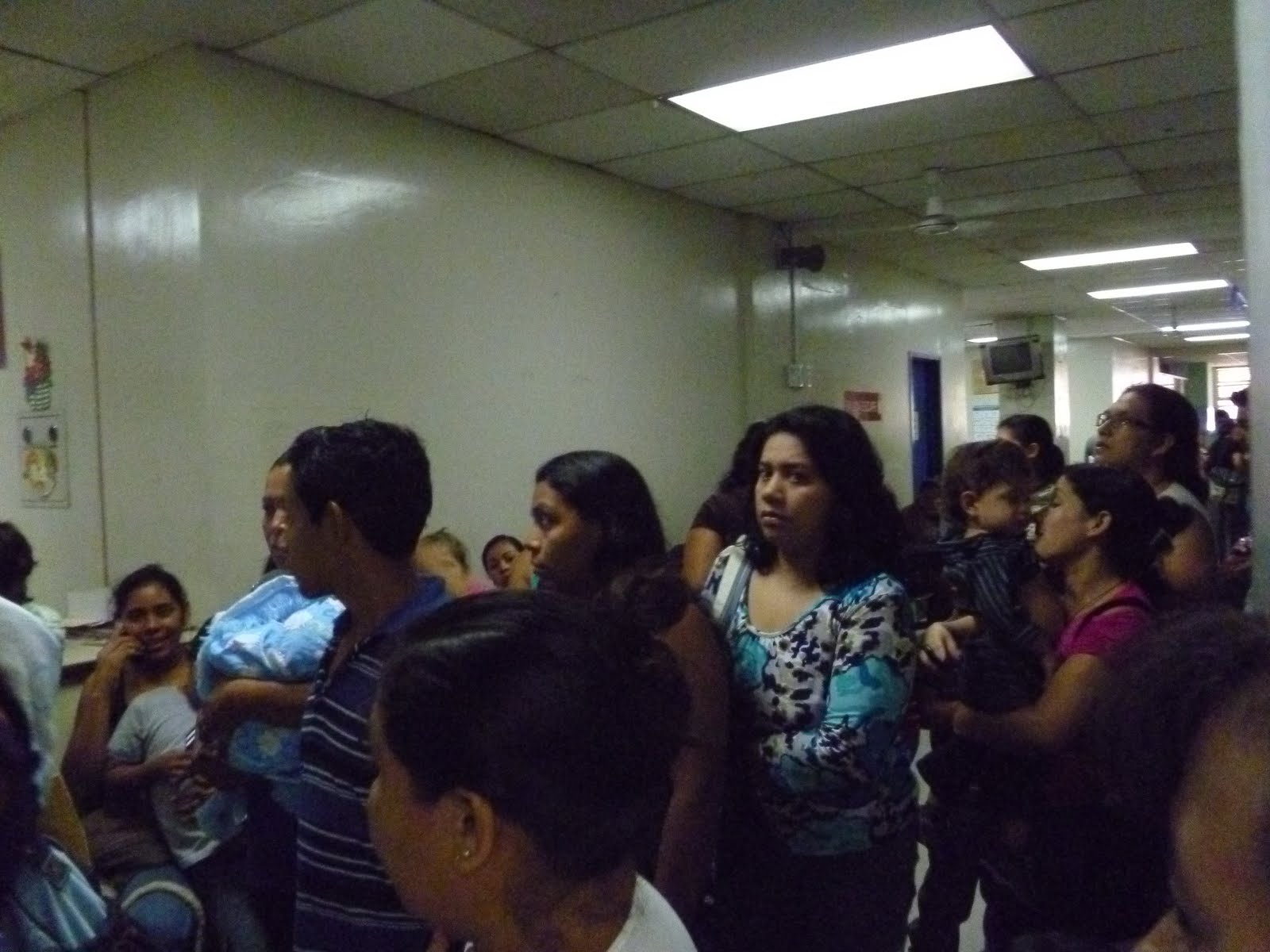
I'd already discovered that invariably appointments at Bloom are set for 6 AM, but I couldn't figure it out - surely the doctors didn't start their clinics that early? By 6 AM I'd found a parking place and we lined up outside the hospital, a commanding multi-story building, with a lot of other parents and children, a woman selling atole (a hot corn drink) and a clown selling balloons. The guard checked Sandra's appointment and let us in. We went down the hall, found the ophthalmology clinic, and sat down. And after quite a while we noticed that a long line was forming in front of the desk outside the clinic - ah yes, no one told us about that part of the ritual. I have to confess that we jumped the line - we really had been among the very first to enter the hospital, and it didn't seem fair to have to go to the very end. It may have helped that I was a gringa, because the secretary let us turn over Sandra's hospital card and appointment. And then we waited some more and after another time that seemed longer than it really was, the clinic secretary got us all lined up in chairs according to arrival time. An orderly procession had been created. This not-very-good photo gives some sense of the feeling of the corridor, full of mothers and some fathers, each tenderly carrying or watching over their child.

It was about 7:30 when we finally got in to see Dr. Dominguez, who checked Sandra's eyes (she has congenital cataracts), scheduled her for pre-tests and surgery, and told me the size of the interocular lens she will need. But those lenses won't be provided by Hospital Bloom, nor will the heart valve needed by Richard, a little boy we met in San Rafael Cedros. Unless the families can raise the money to buy the lenses, or heart valves, or tests that the hospital doesn't perform, or medications that the hospital pharmacy doesn't have in stock, health care gets stopped in its tracks.

This isn't the fault of the staff at Hospital Bloom or at any of the other hospitals. It happens because El Salvador is a poor country and in a poor country's health care system the extras - interocular lenses, heart valve replacements, expensive medications - just don't happen unless someone steps in to help. The children who can profit from ordinary care do well in this system - El Salvador has a good record of pre-natal care, vaccinations, and treatment of normal childhood diseases. And if the lenses or heart valves or medications can be purchased, all the surgery and hospital care and follow-up appointments are completely free. In El Salvador, the cost of health care is relatively inexpensive - doctors and nurses are not paid much at all by U.S. standards - but the cost of 1st world technology is prohibitive.

Children with costly or complicated illnesses are often, in effect, triaged out. Sandra and Richard who needs a heart valve replacement and Gema who needs medication Bloom doesn't carry are lucky to have encountered one of our PeaceHealth mission teams and found sponsors. But for too many children here and in every poor country in the world, the miracles of health care that we take for granted and see as any child's right in the United States are simply too costly and not available.

Monday, December 6, 2010

Meeting the Ecocina


During our November eye screening clinic in San Juan Opico, we had a demon-stration of the Ecocina, a beautifully engineered concrete stove with three important virtues: it uses less than half of the wood needed by a regular wood stove, it is so efficient that it produces no smoke after the first few minutes, and the outside stays cool, so children aren't burned if they touch it.

The Ecocina is the work of Stove Team, International, an organization based in Eugene, Oregon - the location of PeaceHealth's Riverbend and University District Hospitals. Nancy Hughes, the founder, and team members have started factories in El Salvador, Guatemala, Honduras and Nicaragua. We were delighted to connect with Gustavo Peña, the manager of the El Salvador factory. Unable to come himself, he sent his son Gustavo, Jr. - Dr. Peña - who not only brought the stove and his fiancee, who demonstrated it, but gave a day of free dental exams and cleanings to over 30 young Opicans.

We acquired the sample stove, and it stayed in the parish hall for a while (the stoves weigh about 100 pounds, not so easy to move). The parish cook tried it out and liked it a lot - and so now a bunch of orders are going to the Ecocina plant from San Juan Opico. The sample went to the Rodriguez family on Friday - here's a photo of Dina Duvon showing them how it works. We're hoping it will contribute to good health for the children - and good meals for the family.

Wednesday, September 22, 2010

The cost of being safe

Every time I come back to the U.S. I have a few days of being stunned by the differences - the empty streets with no food stands, impromptu markets, funerals or parades ! the smooth traffic moving along the loops and lanes of elegant highway with no cars ever parked on the side! the shops with no gun-toting guard posted outside! This time I started thinking about the cost of all those miles of carefully maintained roadways and highways, all the required parking lots in front of stores, all the elaborate security kept carefully out of sight to make you feel safer.

You see, in El Salvador and elsewhere in Central America, the kind of space and speed and convenience we take for granted in the U.S. is simply too expensive. For example, you consistently enter and exit U.S. highways via exit lanes that end in overpasses, underpasses, clover leaves, each one enormously expensive to build and maintain. They're very safe, because they allow drivers to change direction and exit rapidly (except at rush hours) without colliding with competing traffic. In El Salvador, on most highways you change direction by using a paved U-turn space in the center. You enter the highway by turning right and merging with the traffic flowing in that direction. If you want to go the other direction you wait for 500 meters or so for the next official turning space; you slow down to turn into this, wait for a clear space in traffic going the other direction, turn in that direction and speed up again. As you can imagine, this system means a frequent slowing down and turning from what should be the fast lane, so it's both dangerous and congestive. But it is light-years less expensive to construct than a system of underpasses, overpasses, and one-way exits.

Think about what those choices mean. The U.S. choice is to make speed, flow, and safety hugely important at a huge cost which most U.S. drivers never think about. The Central American choice is to spend a great deal less money for roads that are slower and not as safe, but pretty adequate to move a lot of vehicles and people from one point to another. Which is the saner choice?

Sunday, August 23, 2009

The students


This is Crisseyda, my computer student and Spanish teacher. She's 11 and lives just down the street in Suchitoto, and she loves learning how to use a computer - in her school, there aren't very many computers and each student just gets a few minutes on one once in a while. So Crisseyda and I have explored the basics - turning the computer on and off, opening a program, writing a few sentences in Word. Right now Crisseyda's learning touch typing (OK, keyboarding, I learned in another era) from a cheerful program, the Ten Thumbs Typing Tutor. It's all been fun to experience with her, and our conversation is very good for my Spanish. We're acquiring a useful vocabulary of computer words in both languages. For me, it's good to be a teacher again - and a learner always.

Sunday, July 5, 2009

On time

Jennifer Cowan from Bellingham is my first visitor in the Suchitoto house. Jennifer arrived yesterday right on time (the plane was a little early, but customs was slow). What wasn't right on time was the process of getting a 220 volt line into the house for the stove. Felix the electrician told me he could finish all his work yesterday. Ah, I said, then I can use the stove? Well no, he said, CAESS (a subsidiary of the multinational giant AES, and the privatized provider of electricity here) still has to approve the connection to the main line. Oh, I said, I thought that happened already. Well part of it did, he said, they gave approval for the line to be installed, but now they have to approve the work that's been done. By now I was becoming a bit hysterical, as I explained to Felix that I have four guests visiting in July and had planned on being able to boil an egg. Felix said he'd do his best to hurry the process along.

The argument for privatizing electricity, like so many other "public" services here, was that a private company would provide more efficient service at lower prices. The price of electricity is very high here, and there seems to still be plenty of bureaucracy to slow things down.

I've lived in Central America long enough to know it may be quite a while before the stove actually works, so Jennifer and I stopped in San Salvador for lunch and a quick trip to a hardware store where I bought a single burner that does not need 220 volts to operate. Boiled eggs assured, we drove back to Suchitoto where we found Felix and his son and daughter hard at work. Felix told me he'd hooked up a connection for the stove that I could use while I wait for CAESS. Great, I said, let's see how it works! Seems the hookup is to a 110 volt line, so when you turn on a burner the red "on" light glows - but the burner, alas, does not get warm.

Jennifer is the perfect guest for times like this, ready to adapt to any circumstances. We went out walking, ate pasteles (a deep-fat fried potato puff, totally yummy though perhaps not totally healthy) and pupusas, went to the first two thirds of an excellent concert by the El Salvador Youth Orchestra (Jennifer had been up for about 27 hours at that point, so we skipped the last number) and we did not miss the stove at all.

The orchestra's appearance was preceded by the singing of the Salvadoran national anthem which, speaking of time, goes on forever and seems to incorporate about three different songs, in an inverse relationship to the size of this country. We were all ready to sit down when the theatre's owner announced that now we would sing the Suchitoto anthem. Thankfully, it's shorter. Today I'll start cooking on the single burner, and I'll be glad for that boiled egg.

Tuesday, February 17, 2009

Purposes

Today Eleanor and Kathy and I made some preparations for the cataract surgery mission (co-sponsored by SEE, International) that will be our next big project in April. We wrote some thank you letters, worked on accounts, and compared notes about the Comasagua mission.

I've written a lot about our connection during the week with the people of Comasagua, who have moved each of us deeply. Each person who came on this mission will go back home with a deeper, more heart-felt experience of the realities faced by most peoples in the world. Each of our health providers, back in their super-clean clinics, with pure water available from every tap, will be remembering the difference.

I've said less about two other important purposes of this mission week. We brought together doctors, nurses, physician's assistants, pharmacy techs, interpreters and chaplains (among others) from a variety of PeaceHealth regions, and we brought them together as equals. I love it that on a PazSalud mission all the name tags have first names only (except for Eleanor and I, who have Hna - hermana, Sister - in front of our names. In this trip, Father Ken Olsen was another exception, Padre Ken). The long trips on the bus each day gave everyone time for thoughtful connection and conversation, and the evenings gave us time for fun (as can be seen in the photo above, from our dinner at Beto's: Bob Davis, Nelson Solano, Elba Rivas, James Boyle, Ken Olsen and Elizabeth Lowery gather around Alan and Joan Yordy). So one of the purposes of the missions is to connect PeaceHealth people with each other in ways that reach across the boundaries.

A second, and more important purpose, is simply to remind everyone involved, and many at home who will see the photos and hear the stories, that providing health care is a mission. I've heard many of our PeaceHealth volunteers by now talk about how this week has recharged their own sense of mission, their own dedication to the work. It comes in realizing that you have a gift of healing to give, even without the technology that supports healing in the United States, and in knowing that you give that gift through your respect and kindness, as well as through your skill.

Wednesday, November 26, 2008

Living in Tomorrowland

Sometimes I feel like I'm living in one of the Tomorrowlands that were featured in the Sunday Supplements and World Fairs of my younger days. As, for example, yesterday: acting on a tip from Sister Chero Chuma, I discovered that Skype will not only let me call other Skype-enabled computers free, but will even let me purchase a local telephone number, so friends here can call a Bellevue number and talk to me in El Salvador without a long-distance charge. Amazing!

I also looked on Google Earth for a small town in El Salvador's Usulutan Province that may be a future mission site, and found myself hovering above it, able to identify the church and plaza and inspect the nearby fields.

I've heard stories from our Sisters who ministered in the Phillipines in the 1960s or Cameroon in the early 1970s about letters taking six weeks to get back to England or the United States, telephones that took days of hard travelling to reach in an emergency. Indeed our globe is now so much more intimately connected and that will make my mission so much easier.

But for someone who remembers her sense of awe when copiers first became available in libraries, it's Tomorrowland for sure!

And in Tomorrowland, it's only 32 more days until I fly away.