Showing posts with label health care. Show all posts

Saturday, April 20, 2013

Ready to go

Hard to believe, but this is the last time I'm going to be responsible for one of our PazSalud missions.  I hope to be part of many more, but I'm passing the responsibility, very joyfully, to Darren Streff.  Today's the day our team arrives at the airport (at 7:45 pm) and I'm feeling like everything really is ready:

  • We have our franquicia, the most important piece of paper, that allows us to bring in the medications and supplies without paying customs.  We also had an extra bit of drama - which almost seems inevitable - when we discovered at the end of our first time through the process that the group we were working with didn't have the right kind of license to support a franquicia.  Thankfully, our friends at the Archdiocese came to the rescue, and our amazing customs manager, José Manuel Gonzalez, got the papers through their second round in record time.
  • We have piles of tubs, a tower of water bottles, boxes of heavy instruments, snack food, fans, wood tables made by Mitch Costin for our optometric equipment, plastic shelving, etcetera ready to be loaded on the truck in a few minutes.
  • And I have washed and ironed the necessary shirts and pants, showered, packed my bag.  As soon as this is posted, I'll put the computer in its travelling bag.
  • But more important than any of this, we have a great group of patients waiting for their surgeries, and a great team coming to offer them.  
May it be a week of good work, good health, new friendships and great joy!

Tuesday, March 12, 2013

Doing it right

Our eye surgery mission - a week of cataract and pterygium surgeries that follows up the general medical mission - always begins with a good long list of people who qualify for surgery, according to our optometrists, and who say that yes, they want to have the surgery.  But year after year, we've seen only half the people on our list show up, in spite of info calls and transportation provided.  We have gathered that people are frightened, and that often their families discourage them from going.

Last year we asked Iris Chacon, our wonderful coordinator for San Rafael Cedros, how she thought we could do better, and she suggested that we have a meeting for everyone on the list where they could ask questions and could hear from someone who had the surgery. 

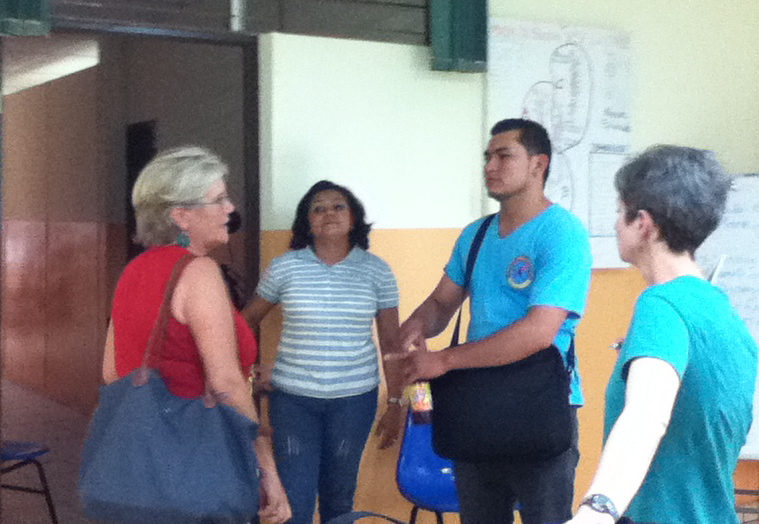
So this year, we invited everyone who qualified for surgery to come to the meeting, held last Sunday in the biggest school in Estanzuelas - and we had a great crowd!  There were probably about 75 people there, 47 of them patients on our list, to hear Lito of San Rafael Cedros talk about his successful cataract surgery, to hear Iris talk about the importance of family support, to hear Darren sum up the steps they would be going through on their surgery day and to hear Marvin remind them where to gather on the morning of the surgery.

Here's Marvin with a very old gentleman who moved right up next to him to hear everything clearly:


And then we got the questions!  Can I still sleep in a hammock?  How long does my father have to wait after hernia surgery before he has eye surgery?  Do I have to keep my head turned up to the sky for two weeks?  Is there a special diet I have to follow?  We were able to put many fears to rest!
And there were a lot of internal conversations, for example among this group of women who checked up with each other about everything that was said:
This is a town where many of the seniors have never learned to read, so it was especially important to share all the information in a meeting - and to send them home with copies that their younger family members could read.

So thank you, Iris, for steering us in the right direction.  Having a pre-meeting for the surgery patients will be part of our practice from now on!

Wednesday, March 6, 2013

Maria del Carmen almost mobile!

Maria del Carmen has now had surgery on the right leg. the one she broke, and the left leg, where she tore tendons, has been freed from its cast.  In fact, she now has two visible legs, for the first time in a month, but she still can only use the left leg.  As you can imagine, after a month of having both legs elevated with minimal movement, it's going to take a while to build up the muscles in the left leg again, and she thinks it will be another month before she's allowed to put any weight on the right leg.  I picked up a walker for her to use - it will return to our PeaceHealth bodega when she no longer needs it - and hope that she'll soon be hobbling about. 

It's a long slow process!  But she is in a good situation right now, staying in her sister's house in Ilopango, in a little room that is right off the kitchen/dining area, so she's right in the middle of everything.  It's a bonus that her 94-year-old father and her stepmother are also staying there for a prolonged visit - in addition to her sister's son, daughter, son-in-law and granddaughter. 

I'd love to share a photo, but Maria del Carmen has steadfastly refused to have any photos taken during this time.  But her spirits are good: after some mourning on the day of the break, as she realized all the changes this was going to mean in her life, I haven't heard one complaint from her (well, not quite: there was a fairly passionate complaint about unresponsive nursing in the Zacatecoluca hospital).  She's clear, determined, and looking for the finger of God along this unexpected pathway.

Monday, February 18, 2013

Day One of the Estanzuelas Clinics

-->
Our first full clinic day in Estanzuelas, and all is very well. 

Yesterday I exchanged congratulations with Marvin Hernandez, our amazing chief organizer for the Estanzuelas community.  I was relieved that we’d come through the airport arrival and the customs process with no problems and in record time.  He was relieved that all the organizational pieces – the invitations to patients, the welcome at a local school with dancers and lunch for 120, the rental of tables and chairs and canopies, the organization of volunteers for the week had gone without a hitch.

And now we’re off and running, working our way through the opening day questions and glitches (there are always a few of these).  Medics have paired up with interpreters, we’ve figured out how to write up the references for patients who need further tests or specialist care, and every clinic is full of Estanzuelans telling their stories, talking about their needs and anxieties, being fitted with new glasses and being heard with attention and respect.

Especially on Monday, it always feels like a river overflowing: local volunteers, PazSalud providers, interpreters and patients: we’re all trying to figure out the flow. By Friday we'll have everything clear - and then we have to leave!

(Photos, top to bottom: Brian checks a young patient's heart rate; Carol helps a woman choose glasses; Darren listens to a story; Lorna and Moises give patients their medications.)


Friday, February 8, 2013

Maria del Carmen in the hospital

On Tuesday I took Maria del Carmen to the National Hospital in Cojutepeque, where she had an appointment with the orthopedic surgeon.  I know the Cojutepeque hospital from our eye surgery week there in 2011 - it's a beautiful hospital, recently built after the 2001 earthquake damaged the earlier site and well run.

We got there at 9 am and were met by Maria del Carmen's sister, Ana Maria Melendez, who has worked at the hospital for 32 years.  She brought a wheelchair and an orderly who huffed and puffed and barely managed to lift Maria del Carmen from the car to the wheelchair - my respect increased for Alcides and Darren, who have both carried her greater distances without breaking a sweat.

The orthopedic surgeon was supposed to be seeing patients at 10.  He arrived at 1 PM, after getting out of surgery.  In those three hours, we got to know some of the other patients and practiced our patience, an essential act in El Salvador.  He looked at Maria del Carmen's X-rays and agreed that her leg needed surgery and pinning, but said that he did not have the equipment for that in the Cojutepeque hospital.

I said that I would be glad to purchase the pin or other equipment needed, and was surprised to hear his answer: the Ministry of Health no longer allowed families or friends to purchase materials needed for surgery, and this rule was being strictly enforced.  I didn't know whether to cheer or weep - it's truly an act of justice that all patients in the national health system are being treated equally, that those who can find some money don't get to jump the line.  But I had so hoped to help Maria del Carmen get her surgery early!

That was not to be.  The surgeon said he would admit her to the Cojutepeque hospital where all the preliminary tests would be made.  Then she'd be transferred by ambulance to the hospital in San Vicente or Usulutan, where she'd have the surgery, and be transferred back to Cojutepeque for rehab.  It did occur to me that it might be more efficient and more effective to move the pins to Cojutepeque!  There was no clear date when the surgery would be done, though I'm hoping that having a sister in the system will help insure that Maria del Carmen doesn't have to spend any more time than necessary in Cojutepeque.

We then took her through a couple of stations for tests - chest X-Ray, blood tests - and up to the surgery ward, to a room with eight beds, where I left her.  We've talked the last two days - all her tests came out well, but she hasn't yet heard anything about when or where she'll go for surgery.  May it come soon.

Thursday, January 31, 2013

Maria del Carmen's very bad day

On Tuesday I was shopping in San Salvador when I got the word that Maria del Carmen had fallen and had a broken leg.  Could I come and pick her up in San Martin?   When I got there, I learned that she'd gone for a peaceful walk down a dirt road and something - a hole hidden by the drifting sand?  a hidden rock? - tripped her, so that she fell badly.  

Her friends got her into my car and I took her to the little National Hospital in Suchitoto where a Doctora looked her over and said that yes, the right leg was clearly broken and it looked as if the tendons had been pulled on the left leg.  But the X-Ray wasn't available at that hour, and the best she could do was to put a protective covering over the broken leg and to suggest we take her to San Salvador or Cojutepeque.

I was due in to the airport to pick up my friend Judy Stoloff, arriving at 9 pm for a vacation in El Salvador, so Peggy O'Neill most kindly took over, driving Maria del Carmen to the Diagnostic Hospital in San Salvador, where she got x-rays and a light cast on the left leg with the pulled tendons.  Surgery or casting of the broken right leg would have to wait until she could get seen at one of the national hospitals.

Peggy got back to Suchitoto with Maria del Carmen a few minutes after I arrived with Judy, and as he'd done throughout the evening, Alcides, a strong and gentle friend, came to carry her to her bed. 

The next day Alcides came again to carry her into the car and we drove into San Salvador for a second opinion from Dr. Cabezas, a good friend of Sister Eleanor's and mine, on whether surgery was really necessary.  He recommended that she spend the next few days with both legs elevated and that she then get her right leg surgically pinned.  He kindly and thoughtfully explained the whole procedure to her, and she said yes, she would do that.

So we bought a bedside commode and returned to Suchitoto (Alcides helping again) where Maria del Carmen has now spent two days in bed with her legs elevated - distracting herself as best she can with books, radio and DVDs.  Val Liveoak, a Quaker with the Alternatives to Violence Project, who's also living at the house this month, has helped with nursing - we've all taken turns, and Maria del Carmen does as much as she possibly can for herself.  She has a date with the orthopedic surgeon at the Cojutepeque National Hospital (the main hospital for our department) on Tuesday, and we'll hope for an early surgery date.

It's such a shocking thing, to go with one fall from being capable and strong and in control to not being able to walk at all.  I have been so struck with Maria del Carmen's spiritual strength which is seeing her through this physical trauma; she is peaceful and cheerful where she could so easily be anxious, fretful.  I am glad that Val and Judy and I have all been able to be there for her and have shared the practical nursing. 

I think, too, how very differently a fall like this would be treated in our U.S. system - X-Rays and casts and surgery would be instantly available, even in a small town, even for people without financial resources, wheelchairs and walkers or crutches too, I think - though perhaps that's optimistic.  Having to wait a week to see an orthopedic surgeon is hard to imagine.  But that is normal here - it would have taken even longer to get seen at the main orthopedic hospital in San Salvador, Hospital Zacamil. 

Here there's not enough of anything - equipment, doctors, medications, hospital beds - and while the rich can get whatever they need, most Salvadorans have to wait and hope that there will still be care at the end of their waiting.  May Maria del Carmen finally receive the care she needs.


Saturday, January 26, 2013

A Circle of Wise Women


Last week, while Sister Eleanor Gilmore (founder of PazSalud) and Kathy Garcia were both here in El Salvador, we called together some of the people who've been our partners on our health missions to gather their ideas on how we can stretch and improve our collaboration with the people of El Salvador.  It's probably not entirely a coincidence that they are all women, though we've also had some amazing men working with us.  Here we are at lunch after the serious discussions: on the bottom row, left to right, Dora Alicia Alas (also known as Iris), a CIS organizer and our coordinator in San Rafael Cedros; me; Kathy; and Dina Dubon, a social worker with Caritas El Salvador and our coordinator in San Juan Opico.  Top row, Leslie Schuld, Director of CIS (Centro de Intercambio y Solidaridad); Rosy Melara, from Hospital San Rafael, who volunteers as our surgery nurse; Rosa Aguiar, of the Alcaldia de Comasagua, who volunteers in our Eyes clinic; and Sister Eleanor.

We talked about the possibility of working with a circuit of municipalities instead of going to a different one each year; we talked about how we can incorporate workshops and perhaps clinics from Salvadoran specialists on subjects like family planning or diabetes prevention and nutrition into our offerings.  We looked at stressing the importance of getting a pap smear in our women's clinic, and the necessity for followup on positives.  We talked about how to break through the fears that keep many seniors from getting the cataract surgery that they're qualified for.  We talked about cooperating more closely with the local government health clinic, the Unidad de Salud.  We talked about how our water filter program can begin to educate the whole community on the importance of clean water.

We came away from this circle of wise women with great ideas for the future, especially for the ways we can partner with Salvadoran organizations to have a long-term positive effect on the health of the communities we work with.  Gracias for the wisdom!

Wednesday, December 26, 2012

In Santo Tomas la Union

This week Maria del Carmen and I are guests of CSJP Associate Sheila McShane, who runs the Clinica Maxeña (that's pronounced mashenya, more or less, and is the Quiche version of Thomas) in Santo Tomas la Union, Suchitepequez, Guatemala.  It's been great to connect with Sheila (working away on her laptop here, in the common dining room) and to see the good work this clinic has been doing for almost fifty years now. 


The Clinica Maxeña is a mission of the Diocese of Helena, Montana and Sheila has been part of it almost from the beginning, though she had to leave for many years during Guatemala's Civil War. Along with Father Kevin, who joined the mission this year, and BVM Sisters Mary and Anna (alas, I don't have their last names!) Sheila forms a small North American community in this very Quiche Mayan community.  Unlike Suchitoto, this is a town where you don't see any foreigners outside the Clinica group and visitors like Maria del Carmen and me. 

Today I toured a very beautiful and very special part of the Clinica Maxeña, the natural medicine garden.  There were some familiar plants - oregano, mint, marigold - but others that seemed fantastic, like this plant with long leaf blades and tiny flowers along the sides of the blades.  It's good for taming parasites, I was told.

Another plant with broad, flat leaves thrust up a group of delicate bell flowers (I didn't learn its purpose):
and the trees hosted their own communities of parasites and collaborators, including a white orchid in bloom:
It's no surprise that the garden was full of butterflies of many different colors, sizes and shapes.  Here's one that was kind enough to pause for a photo:

Indeed, an enchanted garden.  I hope those who work with the traditional medicines made from these plants will be able to keep the knowledge and interest alive among the people of Santo Tomas.


Monday, December 3, 2012

A day in Paradise

Yesterday I was invited to visit the island Tasajera, a place I've heard much about from Dr. Lauren Herbert and Cathy McKay.  About five years ago Lauren, a pediatrician in PeaceHealth's Sacred Heart Medical Center, Eugene, visited the island with Dr. Daniel Perez at the end of one of our medical missions, and she has since been working (along with her church and with the people of Tasajera) to set up a medical clinic and - more recently - to bring wi-fi and the possibility of teleconsulting to the island (through a grant written by Dr. Dany to Conexion, a Salvadoran NGO).  Cathy McKay, a nurse in Bellingham, got involved a couple of years ago, and has helped a group of women on the island to start a sewing cooperative where they make beautiful handbags - the project is named, in her honor, Las Bolsas de Cati. 

Both Lauren and Cathy are visiting Tasajera this week, and they invited me to enjoy Sunday there.  And enjoy it I did, every minute of that day of beauty, peace and serenity - a day in Paradise!

After two hours driving, I finally arrived at La Puntilla, at the very end of the road to the Costa del Sol, where Lauren and Rosa, a health promoter who has the healthiest and most infectious laugh I've ever heard, met me.  We travelled across the estuary by lancha (motor boat) to Tasajera, the name both of the island and the small town at the island's tip, and then boarded a pony cart for the trip to the island's other town, Colorada.
In Colorada, we visited the three-room clinic where Lauren works when she's offering consultas on th island.  A young man was waiting to see her with a long series of problems; he left with a number of medications and instructions:
Then we headed out to lunch, in one of two Colorada comedores, both built out over the estuary, and both run by brothers of Rosa.  Looking out over the river, we ate shrimp, tender shells and all, and the freshest fried fish I've ever tasted.

The comedor's bathroom is also built over the river, a beautiful creation to behold, but I was happy not to need to use it:


From the comedor, we got to see closeup one of the local fishing boats, a true dugout canoe, with two young boys happily fishing (in the background are the mangroves that protect this low-lying island with their barrier of interlaced roots):
Then we got into a lancha and headed out to the confluence, where the Rio Jultepeque joins the big river, Lempa, and they both flow into the ocean.  We swam in the calm salty water of the confluence for a beautiful, dreamlike hour - we had the beaches all to ourselves - then headed back to La Puntilla, passing along the way an enormous number of pelicans, roosting in mangrove trees and in snags on the river:


An amazing, beautiful day.  I came to understand completely why the young folk on the island, when asked if they're interested in going to the capital to study or work say "no."  Who would trade this peaceful and beautiful island, this peaceful and beautiful way of life for the noise and danger of the city?

It wasn't until today that I realized that this place of great natural and human peace and beauty must be one of the thousands of places on our planet endangered by climate change and the rise of ocean level.  This gives me abundant reason to work harder to alter my own ways and to advocate for earth justice.

Gracias, Lauren and Cathy, por un dia en el paraiso and for all you're doing for the people of Tasajera!


Thursday, November 29, 2012

Preparation

Members of our mission teams often ask Kathy and me what we do when we're not in the middle of one of our mission weeks.  I've always found that a hard question to answer because there are so many different parts to the work, but I know that I always seem to have more work than time, and I know the same is true for Kathy (and will likely be true for Darren next year). 

This week it would be easy to answer the question, because this week I've been focused on getting ready for our February mission.  On Tuesday Darren and I (and my cousin Margaret) went out to Estanzuelas to meet with Marvin, our Estanzuelas coordinator, and the cooks who will be making lunch for the mission team and our local volunteers in February.  My job was to explain to Sonia, the group leader, and to the other women the precautions they'd need to take to make sure that all the gringos stay healthy.  We asked them to use bottled or filtered water to wash fruits and vegetables, to wash hands and knives and pots carefully, to avoid some foods that are hard to keep free of bacteria, like lettuce and strawberries (a suspected culprit for several illnesses last year).  We figured out the menus for each day - typical Salvadoran foods - and agreed on a price, $4 per plate per day, that will allow them to include plenty of fruits with each lunch.  We talked about being sure to include enough non-meat items so our vegetarians won't starve.  We said how much our team members enjoy Salvadoran food and how much we'll all look forward to great lunches.

Then we drove over to Alegria, had a great lunch with Marvin at a restaurant with a stunning view over the valley below, and went through the same discussion with Mélida and Berto who are going to organize breakfasts and suppers for us at the retreat house.  Padre Juan José was, as always, a very gracious host - here he is, from Margaret's iPhone photo:
Tomorrow I head for Estanzuelas again, this time to brief our local volunteers and the health promoters who will be in charge of inviting participants to come to our clinics.  In between, I got briefing papers ready (in Spanish, with help from Maria del Carmen) and copied the invitations that the local volunteers will give to our patients and wrote to Dr. Melendez, our helpful contact with the Ministry of Health and even caught up on e-mail.  A few very satisfying days - it always feels good to have the preparations well in hand before everything shuts down in mid-December. 

Friday, September 14, 2012

El Rey de las Burbujas

A couple of days ago I picked up Richard Stanley and his mother, Mari, at their home in San Rafael Cedros and drove them in for Richard's appointment with a pediatric cardiologist in Hospital Bloom.  Mari and I were both on edge because the cardiologist had said that Richard might need a pacemaker, and we didn't want this little guy to have surgery again, just a year after he got his new heart valve.  Richard, on the other hand, seemed to be having a great time, observing every car, motorcycle, pickup, dumpster, truck with the passionate attention of a four-year-old male. 

At the Bloom, Richard had an X-ray and an EKG, and he got a prize for being a prize patient: a little bottle and wand to blow bubbles with.  And as only a four-year-old can be, he was completely absorbed by blowing bubbles and trying to catch bubbles and dunking his wand into the bottle for more bubble soap.  Somewhere along the way, he forgot to be afraid of me (I think the fact that I can drive a car and drove a car that he rode in did much to make me an acceptable person) and passed me the bubble wand.  So we blew bubbles at each other happily for about an hour and a half.
Richard even forgot that he's camera-shy and enjoyed seeing this photo of a bubble that he successfully caught on the wand.  Clearly, he's the Rey de las Burbujas, the King of the Bubbles.  And, as you can see, he's also Spiderman, El Hombre Araña. 

I had to leave before Richard had his time with visiting pediatric cardiologists, but it was a joy to hear later from Mari that the visitors checked all the tests, looked at Richard, and concluded that he doesn't need any interventions, either surgical or medical.  I can blow a bubble or two to celebrate that news!

Thursday, August 23, 2012

Checking in

I've been too long away from the blog, not because there's nothing to report, but because so much has been going on.  Last week Kathy Garcia was here and she and Darren and I did a lot of visiting, preparing and talking.  The preparations included a good visit to Estanzuelas, where we'll have our 2013 general medical mission, and then a visit to the hospital at Santiago de Maria, where we hope to have our eye surgery mission.  At the hospital, we all put on scrubs and booties to get a tour of the surgery suite - which looks great for our work.  As we got ready to leave, I stuffed my scrubs in my bag and picked up another set, which I assumed were Darren's.  The next day I pulled them out and discovered to my horror that I'd run off with someone else's scrubs, and furthermore that there was $3 in the pocket - someone's lunch money.  I imagine this poor soul cursing the gringos!  So this week I had to make the long trip back to Santiago de Maria (it's more than 2 hours from Suchitoto) to hand in the scrubs and confess.  It was the nun who did it!

Among the pleasures of Kathy's week here were visits with two scholarship students who were outstanding volunteers in earlier missions: Walther from Panchimalco, now in the 4th year of his engineering program:
and Alex from Comasagua, who's in his first year, studying psychology at the Pedagogical University:
They are both great guys, very deserving of the opportunity.

Thursday, July 19, 2012

Clean water in the schools

During our February Medical Mission in San José Villanueva, Padre Mario Adin asked us to consider giving Sawyer water filters to each of the public and private schools in Villanueva.  We were delighted to say yes to his request, and today I went to Villanueva with Clelia Estrada of the Caritas office in the Archdiocese of San Salvador and Darren Streff, Maryknoll Lay Missioner to make good on our word.

We met with representatives from the schools and with Health Inspector Miguel Angel Cruz, who'll be doing follow-up to make sure the filters are being properly used and cleaned.  They were a great and very attentive group, watching carefully as Licendiado Cruz demonstrated how to drill a hole in the bucket for the filter connection:
It's hard work!  When I set up the water filter at our house, I was determined to manage the whole process myself, just to know that even a 70-year-old woman could put the filter and bucket together.  I did manage it - though much more slowly than Licenciado Cruz - at the cost of a sizable blister on my thumb. 

Several people wanted to know if it was possible to buy a water filter in El Salvador.  Not yet, I had to say, though I do hope that Sawyer Products will realize that they have a great untapped market in Central America.  Where did I find them in the U.S., and did people in the U.S. use them?  That question rocked me back on my heels for a moment, as I thought about the health gulf between us.  In the United States, filtering your water isn't necessary, though plenty of people do it.  The only place I've seen Sawyer filters in the U.S. is in sports stores, which feature the smaller filters hikers use.  The gulf is the difference between a country where water is purified and tested regularly, held to the highest standards of sanitation and a country where water is almost always contaminated by parasites, bacteria, amoebae, you name it.  Our few water filters only begin to touch the edges of this huge issue of justice.

Still, it's great to know that the schoolchildren of San José Villanueva will have clean water to drink! 

Friday, May 11, 2012

Looking ahead

A couple of weeks ago, after we put all our surgery mission folk on the plane home, Kathy Garcia and I hopped in the new CIS pickup with Leslie Schuld to take a long drive to Estanzuelas, the town Leslie proposes for our 2013 mission.  And since our first question is always "and just where can we put the 28 people on our team?" we stopped first in the beautiful hill town of Alegría (the name means "happiness") to visit the Casa de Retiros (retreat house) run by the Pauline Missionaries.  It's a simple, spacious and beautiful retreat house that borders a finca, a coffee plantation, that's also owned by the padres. The town perches among steep hills, was the home of El Salvador's most famous philosopher, Alberto Masferrer, and has many beautiful moments like this shrine to Our Lady of Guadalupe.  


We were sold even before we got to Estanzuelas, where we were generously welcomed by Marvin Hernandez, who guides the CIS scholarship program there, and Dra. Jakellyne Jimenez, Director of the Estanzuelas Unidad de Salud (the government health clinic).  Dra. Jimenez invited us to use a portion of the clinic for our medical mission and we accepted most happily. Below, left to right, are Leslie, Dra. Jimenez, Marvin and Kathy. 

Tuesday, May 8, 2012

Cristóbal

Getting to know Cristóbal has been one of my joys over the last couple of weeks.   He's a 20-year-old from San José Villanueva who showed up at our eye surgery mission one day in hopes of getting some help for his bad eye.  Our ophthalmologists quickly saw retinal damage, and recommended that he see a retinal specialist.  I made an appointment for him with Dr. Solorzano and met him in the doctor's office, which was a challenge to find (it's in an area where one-way streets and diagonals and dead-ends make nonsense of one's rational driving plan).  Once I got there, Cristóbal and I settled into conversation, and I quickly found out that he speaks excellent English.

It's not because he's lived in the states or had native speakers for teachers.  But a visitor from New Hampshire sent him a set of ESL CDs, and he worked and worked with them.  He must have done that work with great determination and great ability, because at this point, halfway through his first year at the University of El Salvador (he's majoring in modern languages, studying English and French as well as his native Spanish) he's very comfortable and skilled in conversational English.

We had a lot of time to speak English together, as Cristóbal had to get his eyes dilated, a process that always takes quite a bit of time, and then we waited for Dr. Solorzano - who turned out also to have excellent English, due to five years in the U.S. specializing in retinal and glaucoma problems.  He quickly diagnosed Cristóbal with a detached retina - but the damage had happened four years ago, and there wasn't much likelihood of recuperating sight in the damaged left eye.  He recommended a laser surgery to prevent any additional damage to the left eye and to insure that the retina in the right eye would not become detached. 

Happily, that meant coming back for the surgery itself, which happened in Dr. S's office,  and another two hours of English conversation with this talented young man (he also plays piano with a local group).  The surgery hurt, which I hadn't expected - Cristóbal had a fierce headache as well as pain in the eyes - so he was quiet as I drove him home.  But we'll connect again when he comes back next week for a checkup, and I look forward to more conversation in my own native tongue.

Cristóbal is one of eight children of a campesino family, the only person in his family who's ever been to a university.  There's neither TV nor a radio in his home, so it's not surprising that the family didn't have the resources to get him help when the retinal detachment happened (I gather he did see one doctor, who recommended glasses).  Dr. Solorzano is now one of my heroes - he waived his fee and charged only for the cost of the laser equipment.  Cristóbal was sad that his vision couldn't be restored - but for someone with his bright future possibilities, it was "vale la pena," worth the trouble, to make sure his other eye stayed good and strong - lots of books in his future, I suspect, and he'll want to enjoy reading them.

Tuesday, February 14, 2012

Feliz Dia de Amistad

Feliz Dia de Amistad, or Happy Valentine's Day...  I'm more than happy as I look back on our week in San José Villanueva and on the good work of our team.  We saw 1650 patients, most for two or three consults, gave out vitamins and toothbrushes to all, and gave medications and glasses to those who needed them.  We helped five patients in serious conditions, including one pregnant woman in the 9th month who hadn't received any prenatal care, to get to the hospital, and we must have given references for specialized care or further testing to at least 100 others. 

We had a wonderful time together, too - it's amazing that each time our group becomes a living team in about a day, and works together in complete harmony throughout the week.  Of course, as Kathy and I say, it's only the best people who choose to give up a week of their time to work with strangers in a hot and unfamiliar country.  Those strangers - well, long before the end of the week, they felt like friends and family. 


Here are two photos that tell the story of what this week was all about: above a little boy happily wraps himself around a big box of nutritional supplement.  Knowing that malnutrition among children was a major problem in Villanueva, we brought lots and lots of infant formula and supplements.   Below, our volunteer Leann makes friends with a Villanueva family.

Those are great moments to remember on this day celebrating love and friendship.

Tuesday, February 7, 2012

Villanueva, Tuesday

I'd love to give you some of those worth-1000-words pictures, but Í'm using Ayagualo's computer, and can't get to my photos.  Yesterday and today have been full and overflowing - we´ve seen some 650 patients so far, with lots and lots of them needing special attention or a reference into the national health care system.  Our hearts are overflowing with the stories we´ve heard and shared.  And then there´ve been a few cases of just overflowing, as some Salvadoran bacteria tangled with our gringo systems.  It´s been very hot in Villanueva, which makes the return to Ayagualo (not until 7:30 tonight) and the cooler breezes on this hilltop a great joy. 

For another view of our mission week, go to http://wwwpeacehealthorgpaz-salud.blogspot.com/ to read about the experience from the point of view of Barbara, our photo-journalist.

Sunday, February 5, 2012

In San José Villanueva

Our mission team arrived right on schedule Saturday night, at 9 pm, and our only problem in Customs was that one of our tubs had gone missing (it arrived today after spending the night in Houston).  We were on our way to the beautiful Salesian retreat house, Ayagualo, by 11 pm, and arrived at about midnight, still with a little energy available for getting to know each other and talking about the week ahead.
Today we've been getting to know Villanueva and the church/school at the center of the town where we'll be working all week.  Many of us went to Mass and discovered that our host, Padre Mario Adin, is a wonderful homilist and a man deeply committed to the life of his community.  All day there were masses, meetings, study groups, catechism sessions, literacy training taking place in all the corners of the complex.
Our major tasks were setting up the various clinics and the pharmacy, counting out vitamins and bagging them (everyone who comes to our clinics gets a month's supply of vitamins), and having some training sessions with our team and with the local volunteers.
We know from plentiful experience that tomorrow will be a little crazy as everyone tries to figure out her or his job and as the patients flock in to see us.  We also know we're blessed to be here, that we'll be well fed, both at the retreat house (we had pupusas tonight!) and at the parish, where we had a grand lunch today, and that we'll get to return to the beautiful grounds and comfortable rooms (and hot showers) at Ayagualo each night to restock for the work of tomorrow. 
And now it's time for me to catch up on sleep after two very short nights!

Tuesday, August 16, 2011

Richard at home


The last few days have been full of wonderful events and meetings, material for more blog posts than I've had time to write (they'll come along later this week). One of the best times was visiting young Richard Stanley and his mom Mari in their home in San Rafael Cedros. I went with Iris Alas, our San Rafael coordinator, her daughter, and Sergio, one of the community volunteers and Mari's uncle. Richard's new heart valve seems to be behaving well, though getting the medications right has been a challenge. He looks good - more color and more energy than before - and he continues to be a truly squiggly 3-year-old with no interest in having his picture taken. I sneaked in this one when he wasn't looking at me. Mari told me that when all the kids in the hospital were having their pictures taken, Richard was the only one who would have none of it.

Richard and Mari live in the midst of a big Salvadoran family, with Mari's mother and three sisters and a brother and a big bunch of cousins, mostly boys. The family put together the classic almuerzo (luncheon): sopa de gallina india (country hen soup) with a bit of the grilled gallina and salad on the side, with fresh tortillas. It was glorious, and we ate until we could hardly waddle. A great way to celebrate Richard's new life!


Sunday, August 14, 2011

Instructions from a master teacher


When we finished our week of clinics in San Rafael Cedros last February, we gave 80 Sawyer Point One water filters to the community, in care of Iris Alas. Last week Iris invited me to a meeting at which she was handing over about 15 of the filters to women who had completed the necessary steps - they'd come to a first meeting where they had learned about the importance of clean water, and about how much it would save the family in medical costs, someone in the family had been tested for parasites and bacteria at the local health center, and they were ready to spend $5 or $10 (depending on means) to defray the cost of the buckets, which the municipality had purchased.

We met at Iris' house, and for the next hour I had the pleasure of watching a master teacher at work. First, Iris went over the details: starting the treatment for parasites once everyone in the family is using the clean water; using the clean water to wash hands and food; keeping the bucket of clean water covered and off the floor; sending the kids to school with bottles of clean water; making refrescos with clean water; backwashing the filter regularly to keep it clean. That's Iris at right in the top photo, and also in that photo, because I couldn't resist, is the family cat, occupying, like every good cat, the exact center of the space. Everyone, I'm here to tell you, carefully walked around the cat, who took this as her due.

Then three CIS volunteers showed how to put the filter and buckets together, and we watched the tap water flow into the bottom bucket, and then each of the women handed over her family member's lab test and the money, and each received two buckets and the filter kit.

It was a joy to see this being done so carefully because, as Iris says, otherwise the filters wouldn't be well used, or they might be sold or be forgotten. These women had to go through some work and pay some money to get their filters, and because of that they're much likelier to use them for the health of their families - and Iris and the local youth who get scholarships from CIS will be checking up in six months.