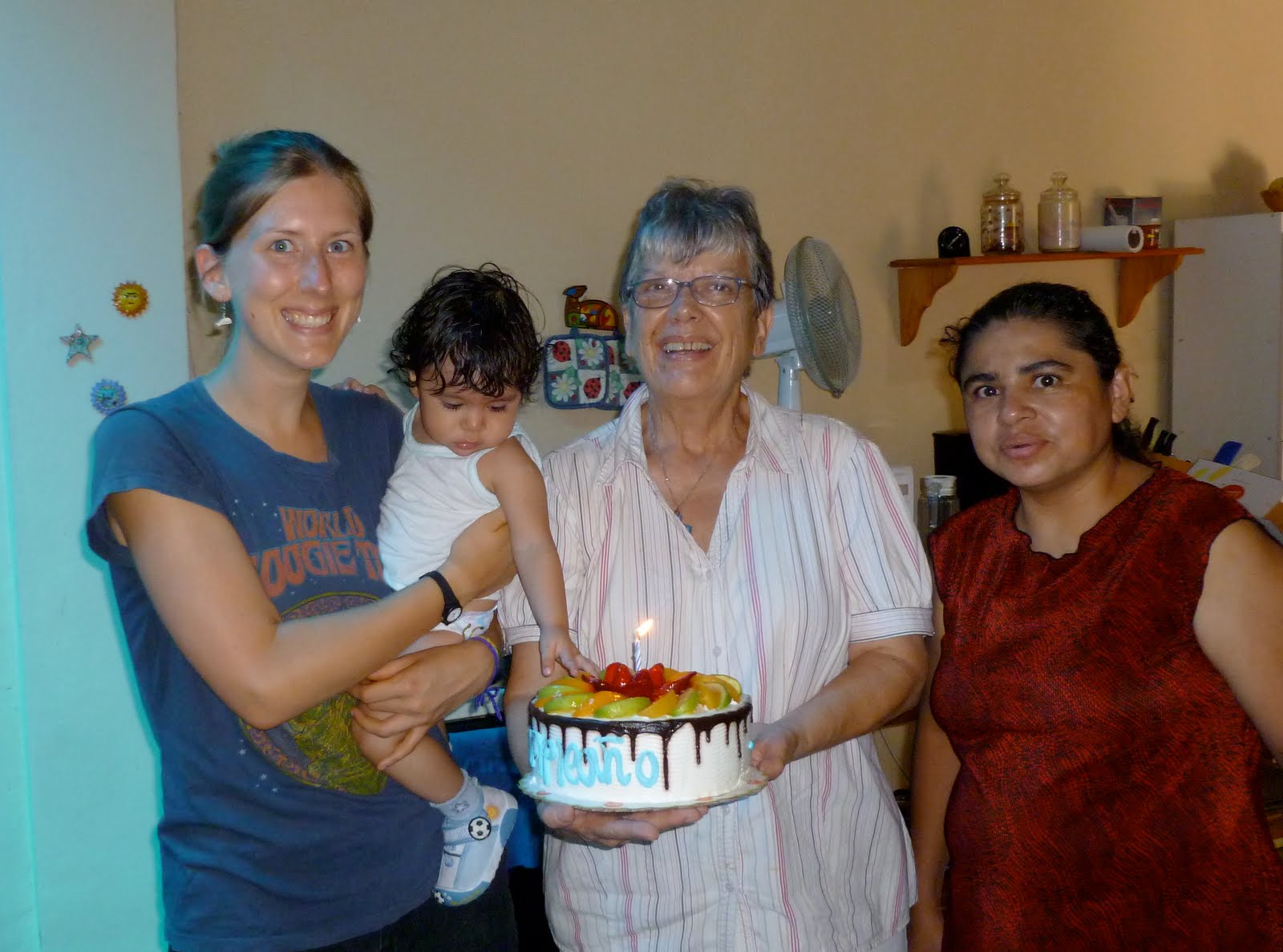
Members of our mission teams often ask Kathy and me what we do when we're not in the middle of one of our mission weeks. I've always found that a hard question to answer because there are so many different parts to the work, but I know that I always seem to have more work than time, and I know the same is true for Kathy (and will likely be true for Darren next year).
This week it would be easy to answer the question, because this week I've been focused on getting ready for our February mission. On Tuesday Darren and I (and my cousin Margaret) went out to Estanzuelas to meet with Marvin, our Estanzuelas coordinator, and the cooks who will be making lunch for the mission team and our local volunteers in February. My job was to explain to Sonia, the group leader, and to the other women the precautions they'd need to take to make sure that all the gringos stay healthy. We asked them to use bottled or filtered water to wash fruits and vegetables, to wash hands and knives and pots carefully, to avoid some foods that are hard to keep free of bacteria, like lettuce and strawberries (a suspected culprit for several illnesses last year). We figured out the menus for each day - typical Salvadoran foods - and agreed on a price, $4 per plate per day, that will allow them to include plenty of fruits with each lunch. We talked about being sure to include enough non-meat items so our vegetarians won't starve. We said how much our team members enjoy Salvadoran food and how much we'll all look forward to great lunches.
Then we drove over to Alegria, had a great lunch with Marvin at a restaurant with a stunning view over the valley below, and went through the same discussion with Mélida and Berto who are going to organize breakfasts and suppers for us at the retreat house. Padre Juan José was, as always, a very gracious host - here he is, from Margaret's iPhone photo:
Tomorrow I head for Estanzuelas again, this time to brief our local volunteers and the health promoters who will be in charge of inviting participants to come to our clinics. In between, I got briefing papers ready (in Spanish, with help from Maria del Carmen) and copied the invitations that the local volunteers will give to our patients and wrote to Dr. Melendez, our helpful contact with the Ministry of Health and even caught up on e-mail. A few very satisfying days - it always feels good to have the preparations well in hand before everything shuts down in mid-December.
Showing posts with label food. Show all posts
Thursday, November 29, 2012
Saturday, November 24, 2012
Down by the seashore
My cousin Margaret Rooker has been visiting this week, and we've had a great time talking and remembering and playing and enjoying El Salvador. We managed a complete Thanksgiving feast for seven with turkey, an outrageously good cranberry sauce, and appropriate accompaniments - best of all, perhaps, the inside-out apple pie ala mode with a crust of oatmeal, pecans, and the local artesanal cane sugar, dulce de panela.
And then we stuffed all the leftovers in the refrigerator and took off for the beach where we walked and talked and watched the surfers and splashed and dabbled and ate good food....Here's Margaret at Roca Sunzal, basking in the summer sun on the day after Thanksgiving. Tomorrow we're going to take the turkey out of the refrigerator and feast on with my friends Rosy Melara and Nena Angel. It's always time for a good party!
Labels:
El Salvador places,
Feast Days and Holidays,
food,
ocean
Wednesday, August 15, 2012
Fiesta de Maíz
Here in Suchitoto, and in many other towns in El Salvador, we celebrate the first corn harvest with a Fiesta de Maíz, which is also a celebration of the many farming villages and communities that are part of the Suchitoto municipality. Kings and Queens of Maíz from the villages and women carrying baskets of fruit on their heads are part of a joyous procession that winds its way through the town to the church for the main Sunday Mass, after which we all pour into the parque central to stuff ourselves with elote, or fresh corn: tamales de elote, atole (hot corn drink), roasted corn-on-the-cob, elote loco (cooked corn-on-the-cob with decorations of, I think, ketchup and mayonnaise (among others), and riguas, my favorite, corn pancakes wrapped in banana leaves and grilled.
A glorious party, and a festival that speaks to the central importance of corn - hard, white Salvadoran corn - in everyone's life here. From the daily tortilla, which is the daily bread of every Salvadoran, to these festival foods it's clear that corn is the staff of life, as it was for the Mayan ancestors centuries ago. ¡Que viva la Fiesta de Maíz!
Labels:
Agriculture,
campo,
Feast Days and Holiday,
food
Saturday, July 28, 2012
Friends in Agua Escondida
Last week Darren Streff and I visited some of our friends in Agua Escondida - Darren's a Maryknoll Lay Missioner who's volunteering with PazSalud, and I wanted to introduce him to a few favorite folk. We started with Doña Carmen Aviles, who has been a community volunteer, chef extraordinaire, hostess and ranchera singer for our two missions in San Juan Opico (Agua Escondida is a colonia of San Juan Opico). Carmen gave us a tour of her family's farm, which included a charming young goat and a pelibuey (a tribe that's explained as half-sheep, half-goat and prized for meat) and a very fruitful orchard, where we found some little red peppers. Were they hot, we asked? Oh yes, said Carmen. Darren tried a small bite and said they weren't very hot. I tried a small bite and went up in flames at about the moment that Darren said "oh, on second thought..." They are extremely hot, and I can't imagine how Salvadorans, generally resistant to anything too picante use these - perhaps on a one part per million basis in a salsa? I never leave Carmen's without gifts for the kitchen, and this time we left with peppers, ginger root (Darren's going to start a new plant in his patio) and a pineapple.
Then we went with Carmen to visit Gloribel and her mother Hortensia, who live next door. With Carmen's help, we've been sending the two of them to a special school for the deaf in Santa Ana, where Gloribel has been able to learn both Spanish and sign language for the first time in her 11 years. Gloribel was delighted to see us and to show off her notebooks, her certificate for completion of the preschool program (she's now in first grade) and some of her new signs. And Hortensia added a beautiful squash to our stash in the back seat.
We followed up with a visit to Iris and her family. Iris, daughter of Gumersindo, another of our great San Juan Opico volunteers, is headed for two years at North Central Technical College in Wausau, Wisconsin, thanks to a U.S. AID scholarship. It turns out that Darren grew up in Stevens Point, about 30 minutes from Wausau, so he was able to tell Iris what a beautiful place she'll soon be living in. Iris' mother, who makes the best tamales I've tasted in El Salvador, had tamales ready for us to eat - and a big bag to take home.
Our next stop was a quick one, to visit Sonia and her family. They usually live in a different colonia, Arenal, but they'd all been sick the past week - sounded like a flu - and were staying with family near Agua Escondida.
Then we headed up to Huisisilapa (I'm very proud of being able to spell that!), a colonia of San Pablo Tacachico, where we visited with Ylda, who arrived back from a new security job in the Government Center just a few minutes after we got to her house. (I was relieved to know that she didn't have to tote a gun.) She, too, had to feed us - tortillas and beans and cheese, with apologies that there wasn't a real almuerzo (lunch) ready. A good thing, since we were already full of tamales.
And so we headed back to San Salvador, where I dropped Darren off, full of tamales and tortillas and beans and cheese, with good things for the kitchen and garden. Altogether, a day full of gifts.
Then we went with Carmen to visit Gloribel and her mother Hortensia, who live next door. With Carmen's help, we've been sending the two of them to a special school for the deaf in Santa Ana, where Gloribel has been able to learn both Spanish and sign language for the first time in her 11 years. Gloribel was delighted to see us and to show off her notebooks, her certificate for completion of the preschool program (she's now in first grade) and some of her new signs. And Hortensia added a beautiful squash to our stash in the back seat.
We followed up with a visit to Iris and her family. Iris, daughter of Gumersindo, another of our great San Juan Opico volunteers, is headed for two years at North Central Technical College in Wausau, Wisconsin, thanks to a U.S. AID scholarship. It turns out that Darren grew up in Stevens Point, about 30 minutes from Wausau, so he was able to tell Iris what a beautiful place she'll soon be living in. Iris' mother, who makes the best tamales I've tasted in El Salvador, had tamales ready for us to eat - and a big bag to take home.
Our next stop was a quick one, to visit Sonia and her family. They usually live in a different colonia, Arenal, but they'd all been sick the past week - sounded like a flu - and were staying with family near Agua Escondida.
Then we headed up to Huisisilapa (I'm very proud of being able to spell that!), a colonia of San Pablo Tacachico, where we visited with Ylda, who arrived back from a new security job in the Government Center just a few minutes after we got to her house. (I was relieved to know that she didn't have to tote a gun.) She, too, had to feed us - tortillas and beans and cheese, with apologies that there wasn't a real almuerzo (lunch) ready. A good thing, since we were already full of tamales.
And so we headed back to San Salvador, where I dropped Darren off, full of tamales and tortillas and beans and cheese, with good things for the kitchen and garden. Altogether, a day full of gifts.
Friday, May 25, 2012
Fruiting season
Yes, the rains have come, it's officially winter, and along with the rains comes the ripening and plopping of millions (I'm not exaggerating here, or only a little) of the nances that grow on the tree in my patio and fall, sometimes with an amazingly loud plop, into the patio. I have yet to meet a Salvadoran who doesn't adore nances and rush to pick them up. I have yet to meet a gringo who likes them very much, so it's a joy to give them away. Lately we've been filling a gallon bag each day with these cherry-sized fruits. Here they are, making a wreath around our rain drain where they were blown in a huge tormenta last Thursday:
It's not just nances that are ripe right now. I had lunch today with Alex Hernandez, one of the students to whom we've given a scholarship for university studies, and he brought me a huge bag of fruit from his mother which included zapotes, a wonderfully rich tasting red-orange pudding inside a dull brown skin; marañones japoneses, a cashew relative without the nut, red-skinned with a white, mild interior; and uvas salvajes, wild grapes, deep purple-black round fruits with a tart-sweet pulp inside. Ah, and it's also the season for avocados, mangoes, lemons, oranges, and who knows what else. So it may be the case that in this climate fruits tend to ripen at the beginning of the rainy season, with the tree or vine beginning its next cycle during the rains. Someone who knows the biology and climatology of Central America could probably explain this. I'm just enjoying the results.
Saturday, September 10, 2011
Raindrops
Labor Day in New York City was clear and beautiful, but then it began raining in New York and New Jersey. I looked forward to escaping to New Mexico, where afternoon rains sometimes happen in summer, but where gray days are practically unheard of.
It must be Seattleite karma, but it has been raining in Santa Fe ever since I arrived on Thursday evening. Now this is grand for New Mexicans - everything greens up, forest fires are no longer a major worry, the rivers are running full - but a little discouraging for visitors, especially since this is the Fiesta weekend in Santa Fe.
All the same, I had a wonderful day yesterday with my friends Pat D'Andrea and Mary Lou Carson, visiting Chimayo, up north from Santa Fe (there we are in the photo). One of my fondest memories is of visiting the Sanctuario de Chimayo with my parents on Holy Saturday, 1969 when I was new to New Mexico. It was a simple adobe chapel then, with the room off to one side where you could find the healing dirt that made Chimayo a pilgrimage site. A tiny old woman asked me to help her in the chapel while my mom and dad were still up in a shop on the main road. When they came in to the Santuario, they were horrified to see me up on a chair doing something to one of the statues, and I had to quickly explain that I was helping out by taking the veils off the statues in preparation for the Easter Vigil (though I wouldn't have known about the Easter Vigil at the time, then being mostly an agnostic).
Yesterday, 42 years and a few months later, it was hard to recognize the Santuario, now surrounded by plazas and car parks, gift shops, and some heavy and unattractive stone crosses within archways (in the background of the photo) that will probably become Stations of the Cross. When we got to the end of the long entry ramp, we found the old chapel of the Sanctuario looking simple and New Mexican, much the same as ever, but it was hard to see it surrounded by all the trappings of a tourist destination. Thankfully, we escaped to the Rancho de Chimayo, where the rain had forced everyone inside from the terraces. We almost didn't get a table, but then were invited to have lunch at the bar, where we feasted on tamales, carne adovada, flautas, posole, frijoles and sopapillas, the very best of New Mexico's wonderful food, and talked as only old friends can talk. The rain couldn't dampen that pleasure!
Later in the day, Pat and I walked down her block to pick up some tamales from her neighbor, Jenny Martinez, who also showed us her lovely collection of images of the Virgin - or the Lady, as Jenny called her. Jenny, who has been praying for me during my breathing crisis and return to health (along with the members of Pat's sangha), shared her memories of Chimayo and sadness at its tourist transformation. And she gave me a little cross to carry back to El Salvador with me. I'll remember Jenny when I hold it, and I'll remember my time in Santa Fe as filled with sunshine of the spirit.
Tuesday, August 16, 2011
Richard at home
The last few days have been full of wonderful events and meetings, material for more blog posts than I've had time to write (they'll come along later this week). One of the best times was visiting young Richard Stanley and his mom Mari in their home in San Rafael Cedros. I went with Iris Alas, our San Rafael coordinator, her daughter, and Sergio, one of the community volunteers and Mari's uncle. Richard's new heart valve seems to be behaving well, though getting the medications right has been a challenge. He looks good - more color and more energy than before - and he continues to be a truly squiggly 3-year-old with no interest in having his picture taken. I sneaked in this one when he wasn't looking at me. Mari told me that when all the kids in the hospital were having their pictures taken, Richard was the only one who would have none of it.
Richard and Mari live in the midst of a big Salvadoran family, with Mari's mother and three sisters and a brother and a big bunch of cousins, mostly boys. The family put together the classic almuerzo (luncheon): sopa de gallina india (country hen soup) with a bit of the grilled gallina and salad on the side, with fresh tortillas. It was glorious, and we ate until we could hardly waddle. A great way to celebrate Richard's new life!
Thursday, May 26, 2011
A source of comedy indeed
During our surgical mission, I spent time in the afternoons with our volunteers from San Rafael Cedros, Yanci and Victoria (in the photo with Iris Alas, our Cedros coordinator). Yanci and Victoria were gigglers, and they found my Spanish pretty hilarious from time to time (as it is from time to time). So I tried to explain to them that one of my goals was to be a source of comedy for Salvadorans - only instead of saying that I wanted to be a fuente de comedia, I heard myself saying that I wanted to be a fuente de comida, a source of food. And, strangely enough, they thought that was really pretty funny.
Onward to further adventures in mangling the beautiful Spanish language!
Friday, March 11, 2011
The chicken or the egg?
That old and worn-out question, - Which comes first, the chicken or the egg? - got new meaning for me on Thursday when I accompanied Leslie Schuld and Iris Alas of CIS (Centro por Intercambio and Solidaridad) to meet a group of women in Guacotecti, in the Departamento of Cabañas, who are about to start their own chicken-and-egg business, with the help of a grant from the Hilton Fund for Sisters. CIS asked me if I would be involved - the presence of a Sister in the program is a requirement - and I jumped at the chance to experience the beginnings and growth of a community micro-enterprise.
I surely wasn't there as a poultry expert! I learned a lot in a few hours: the women will be buying about 1000 young hens (they cost about $9 each) and those young hens will lay like crazy - an egg a day is the expectation - for about a year. Then they start slowing down (understandably) and it begins to cost more to feed them than than be recouped in egg production: then it's time to sell the hens for the cooking pot, get new youngsters, and start the cycle again. This is NOT a romantic business!
But it seems to be a very possible good business for the eight women who are the initial group. There are no egg producers nearby, so they should have a good chance to become the main egg source for their area. According to the women, Cabañas is a fairly poor district, with little economic opportunity. They hope that their enterprise will lead to others and to more at-home possibilities for women and families. They've taken courses in poultry raising, they've found land they can lease for minimal cost, and they're ready to go.
Meanwhile, they fed us lunch: would we like an avocado and a tortilla? they said, but what came out to the table was sopa de gallina india, (country hen soup) the afterlife of one of the local chickens that pecks around the yard - not one of their special laying hens, those haven't yet been purchased. Sopa de gallina india should be the national dish of El Salvador, next to the pupusas. It's delicious, full of fresh vegetables, and always served with the grilled gallina on the side. A true gallina india doesn't have a lot of flesh, and that flesh is tough - but delicious. This sopa was a good promise of futures to come from this venture and from these women.
Tuesday, February 1, 2011
Ready

It's only Tuesday, the PazSalud volunteers don't arrive until late Saturday evening, and I am in a most uncharacteristic state of having almost everything ready. Our franquisia, customs permission, is in hand and copied. Snacks and soft drinks and coffee and water are sitting in our bodega (storeroom). I've met with our local volunteers and with the women who'll be cooking our lunches, I've talked to the retreat house where we'll be staying the first six nights and the hotel where we'll spend the weekend. I've checked in with the San Rafael Cedros health clinic and with the police and with the Mayor's office.
My to-do list, impressive last week, just has a couple of things left for each day this week. I still do have to print some forms, iron shirts, pack my bag.
I was so delighted to be this close to ready that I celebrated this afternoon with a cooking orgy - made a bean soup with roasted vegetables, roasted red pepper salsa, and a ginger/garlic/honey tea I've been brewing to keep my throat and lungs happy. The house smells amazing. And I'm ready for a week of the best hard work in the best company possible.
Tuesday, January 25, 2011
Satisfactions

Today was full of satisfactions. First thing in the morning, last thing in the afternoon, I helped some of my favorite scholars get ready: Walther needed some extra cash for lab and materials fees, as he continues his 5-year program toward an engineering degree. Then, in the afternoon, I helped Rosita and her girls, Lupita and Edith, get backpacks and notebooks and colored pencils - they're in 4th and 5th grade.
In between those happy moments, I had the satisfaction of completely understanding a couple of relatively complicated phone calls from strangers - I must really be picking up my level of Spanish, though sometimes it seems as if I'll never master it - finding two challenging locations in the city, and picking up medications and eyeglasses for our clinics. Then I came home and made a stir-fry with roasted red pepper sauce, cooking to my pleasure without a recipe - and it turned out well.
None of this solves the deeper problems of the world or the terrible crises of El Salvador, crises of poverty and crime that I wrote about earlier this week. But it's good to have a day of minor satisfactions. Those, too, are real.
Tuesday, January 18, 2011
Getting ready
I'm all over the scorpion bite, I'm happy to say, but it was an unforgettable experience. Now taking the flashlight with me AND putting my shoes on when I go to the bathroom in the night. Never mind, the next thing will be something else I don't expect.
We are a little less than three weeks from the arrival of our General Medical Mission, and there's a lot of organizing and preparing on my plate before then. Today I drove over to San Rafael Cedros to talk with Iris Alas, our wonderful local organizer, about food for our hungry team. We met with Doñas Angela, Maria Elena and Mirtala, and I can tell that we will, once again, feast like kings and queens. They've cooked for delegations before and they know what to do to keep our stomachs calm and our hearts happy.
San Rafael Cedros is one of the prettiest Salvadoran towns I've seen - sparklingly clean, with freshly and brightly painted stores. I should have photos to post, but I keep forgetting - eventually some will show up. It's a small town with a lot of surrounding country communities, and it's a well-organized town that has had some great successes recently in combating crime and delinquency. It's going to be a joy to get to know San Rafael Cedros better.
We are a little less than three weeks from the arrival of our General Medical Mission, and there's a lot of organizing and preparing on my plate before then. Today I drove over to San Rafael Cedros to talk with Iris Alas, our wonderful local organizer, about food for our hungry team. We met with Doñas Angela, Maria Elena and Mirtala, and I can tell that we will, once again, feast like kings and queens. They've cooked for delegations before and they know what to do to keep our stomachs calm and our hearts happy.
San Rafael Cedros is one of the prettiest Salvadoran towns I've seen - sparklingly clean, with freshly and brightly painted stores. I should have photos to post, but I keep forgetting - eventually some will show up. It's a small town with a lot of surrounding country communities, and it's a well-organized town that has had some great successes recently in combating crime and delinquency. It's going to be a joy to get to know San Rafael Cedros better.
Sunday, December 19, 2010
Christmas visitors
Last night I picked up Sisters Margaret Byrne, Kristin Funari and Charlotte Davenport at the airport & drove them up to Suchitoto, so happy to have them staying with me for Christmas week. Today we went to church at noon and then made our way to La Casa de Escultor, the Argentinian grill run by Margarita and Miguel Martino. Peggy O'Neill joined us for a grand and memorable meal - steak, sausage, lots of grilled vegetables and flan, and we spent most of the rest of this nice, slow day digesting it. Somewhere in the middle of that time Kristin and Margaret woman-handled our biggest ficus up to our rooftop terrace, where we're planning to create a sitting spot. This was a job I thought I'd have to hire local muscle for - pretty impressive these sisters!
Meanwhile, the disco that backs up to our back wall is playing away, but it's for a quinceañera (15th birthday party) and the music is a lot more mellow that usual - it will probably end earlier as well. Or at least, so we hope! And I've had the pleasure of introducing Charlotte and Kristin, who've never been here before, to the town and the local geckos. Margaret ministered here in the first years of the 1990s at the Jesuit Refugee Service center at El Despertar, so she's an old hand on geckos and Salvadoran life.
Labels:
food,
friends,
Sisters of St. Joseph of Peace,
Suchitoto
Monday, December 6, 2010
Meeting the Ecocina
During our November eye screening clinic in San Juan Opico, we had a demon-stration of the Ecocina, a beautifully engineered concrete stove with three important virtues: it uses less than half of the wood needed by a regular wood stove, it is so efficient that it produces no smoke after the first few minutes, and the outside stays cool, so children aren't burned if they touch it.
The Ecocina is the work of Stove Team, International, an organization based in Eugene, Oregon - the location of PeaceHealth's Riverbend and University District Hospitals. Nancy Hughes, the founder, and team members have started factories in El Salvador, Guatemala, Honduras and Nicaragua. We were delighted to connect with Gustavo Peña, the manager of the El Salvador factory. Unable to come himself, he sent his son Gustavo, Jr. - Dr. Peña - who not only brought the stove and his fiancee, who demonstrated it, but gave a day of free dental exams and cleanings to over 30 young Opicans.
We acquired the sample stove, and it stayed in the parish hall for a while (the stoves weigh about 100 pounds, not so easy to move). The parish cook tried it out and liked it a lot - and so now a bunch of orders are going to the Ecocina plant from San Juan Opico. The sample went to the Rodriguez family on Friday - here's a photo of Dina Duvon showing them how it works. We're hoping it will contribute to good health for the children - and good meals for the family.
Friday, November 26, 2010
Giving Thanks
Yesterday Margaret Jane and I invited Peggy O'Neill, Frank Cummings (a Quaker who runs a scholarship program here) and five of the six volunteers from the U.S. working at the Centro Arte para la Paz this year (the sixth, Christy, is visiting home) to our house for a Thanksgiving feast. A grand feast to which everyone contributed, it included a brined and roasted turkey, stuffing, gravy, mashed potatoes, sweet potatoes, squash, beans, corn on the cob, rolls, wine and cranberry sauce; and then there were desserts - arroz con leche, pumpkin pie, and lemon ice. We ate and ate and ate and talked and prayed and enjoyed our special feast day on a day when nothing in particular was happening in Suchitoto.
Here's the turkey before the feast began and the group at the feast's end. And I have to tell you that it seems very strange to be cooking turkey and hosting a Thanksgiving dinner on a bright, sunny day with the temperature somewhere between 85 and 90. In Seattle, my family and friends are recovering from a snow storm, and I gather that it's cold elsewhere in my home country.
But it's always good to pause and give thanks, with or without a feast, and this year I continue to be grateful for being here in Suchitoto, in El Salvador, in Central America where I'm learning so much and growing too (not just from the feast, though that helped!).
Labels:
Feast Days and Holidays,
food,
friends,
Suchitoto
Wednesday, September 29, 2010
Kale

On Monday, I'm happy to say, my doctor, Anita Shaffer, listened to my lungs and pronounced them clear. It's a joy to be up and about again, doing some of the things I treasure during my trips home. One of them is cooking kale - with garlic and pinenuts and olive oil, braised rapidly, it's a glorious dish, all the better because kale never, ever shows up in Salvadoran markets. I cooked that tonight along with a bean soup that I learned to make in El Salvador - roasted tomatoes, onion, garlic and jalapeños pureed with red beans, ancho chiles and stock, served with avocado, sour cream (or crema in El Salvador), and chives. This was for my sister friends in Prospect House, a community on Capitol Hill that I used to live in, and they loved it. I even found coconut ice cream for dessert, which has always been the PazSalud specialty.
I haven't found a source of chives in El Salvador, so I'm bringing some seeds back, along with seeds for a cherry tomato suited to the tropics, basil, amaranth and endive. It'll be fun to see how it all does, growing in pots up on our sun deck/clothes drying deck. Got to be a sign of good health, creating and rejoicing in favorite flavors. I'm thankful to be enjoying it all.
Labels:
food,
gardens,
Sisters of St. Joseph of Peace
Wednesday, September 15, 2010
Feliz cumpleaño
Yesterday we had a little first birthday party for my godson, Alejandro Alvarenga, a week before his actual birthday, since I'll be in the U.S. then (flying up this Saturday, Sept. 18th and returning Oct. 16th). Alejandrito is now launching himself on brief, breathless totters between one adult and the next, and by the time I'm back he'll be running full out. He enjoyed his present, a turtle pull-toy that plays music when you push buttons (Ani is going to be awfully tired of those tunes in two weeks), but what he really enjoyed most was the wrapping paper, which was fun to eat, and the plastic cups I let him bang around. Why do we even bother buying presents for babies? I'd have to admit that we do it for ourselves. He did get properly involved in his cake, as you can see, and enjoyed playing with Margaret Jane and Korla and me and his folks, and we all had a grand time. You can't quite see it, but the cake is appropriately decorated, in blue, with Feliz Cumpleaño (thank you, Pan Lilian) for that precious one-and-only first year.
Sunday, August 22, 2010
Corny day
Today was Suchitoto's Festival de Maiz, corn festival, which began with a procession featuring kings and queens of maiz coming in to the church decorated with cornstalks. We had just one Mass today, at 9 AM, so the church was crowded, everyone in the pews sitting haunch to haunch and people standing in the aisles on both sides. The readings of the day were a great fit:
And people will come from the east and the west and from the north and the south and will recline at table in the kingdom of God. For behold, some are last who will be first, and some are first who will be last.
Or, as the Salvadoran hymn puts it, Vamos todos al banquete, en la mesa de la creacion - let's all go to the banquet at the table of creation, where the last are first and the harvest is celebrated. Here in Suchitoto, at least on this day and this feast - dreamed up years ago by Srs. Peggy O'Neill and Pat Farrell - we were all the sons and daughters of the corn. And we all ate:
riguas (completely delicious fresh corn pancakes cooked in banana leaves), atole, tamales, tortas, and corn on the cob. Even with the rain falling unseasonably early, it was a feast.
Friday, August 20, 2010
La casa de la abuela
This week I went with my godson, Alejandro, and his parents, Ani and Alex, to visit Alex' mother who lives outside the community of Santa Isabel Ishuatán, high in the hill country of the Cordillera de Balsamo. We had a fine time at la casa de la abuela, grandmother's house, eating our way happily through a continual feast of the best country life has to offer. Doña Francesca started us off with atole de elote, a soup of fresh sweet corn flavored with cinnamon and accompanied by ears of fresh corn. A little later Alex cut down some coconuts, and we enjoyed coconut water and meat. Almuerzo, the main meal, came at about 3 PM and featured a chicken who'd recently been running around, rice, vegetables, tortillas, a salsa de chile, and fresh cheese that Doña Francesca made as we watched.
Then it was time to make tamales de elote, fresh corn tamales, which are delicious. Doña Francesca is an old hand at these, and she taught Ani to make them. I tried the art, too, and feel a little sorry for anyone who got one of my understuffed and messy tamales. Along with beans and rice, the tamales were the centerpiece of supper. I fell into bed feeling like a stuffed tamale myself.
Doña Francesca's house and farm were full of flowers which attracted an amazingly diverse group of butterflies, fruit trees (mango, coconut, orange and many more), and fields - a small milpa for corn and a rice field. Like all the Salvadoran homesteads I've visited, her farm is a celebration of diversity where livestock (chickens, geese and a rabbit), grain crops, fruit crops and vegetables grow in happy abundance. According to the measurements of the U.S.A., Doña Francesca would be poor, and her life has been hard in many ways. But she has been a nurturer of life, both in her farm and in her family: 19 years ago, in her 50s, she adopted a baby whose mother couldn't afford to bring him up, an addition to her family of eight, and Wilson is now finishing his high school degree, hoping to study law at the University. That generosity of life and spirit, which I meet again and again in El Salvador, is a richness beyond economic price.
Oh yes, and I also had a wonderful time playing with Alejandrito, who likes nothing better than to go walking with someone holding his hands. Balancing: what a challenge! But he'll soon be off on his own.
Labels:
Agriculture,
El Salvador people,
family,
food
Sunday, August 8, 2010
Lemons
And this year it has been producing about 35 lemons every day. What can you do with 35 lemons a day? I've been making and drinking lemonade in quantity; I've frozen lemon juice cubes; and I have a big bottle of lemon juice in the refrigerator. Each day we put that morning's lemon harvest in the black clay bowl on our table. When I pray in the morning, looking out into the patio, there's a scent of lemon everywhere. The lemons keep coming and when I look up at the tree, it still has lemons beyond counting.
So we've been doing what people in the Northwestern U.S. do when the zucchinis ripen: every day, we try to figure out who we can give lemons to. Margaret Jane takes them to the Centro Arte para la Paz, I take them on all my trips to the capital. What a glorious excess! And for years I imagined how wonderful it would be to have a lemon tree in my yard. It IS wonderful to be bombarded with this glorious excess.
Subscribe to:
Posts (Atom)