Showing posts with label El Salvador people. Show all posts

Sunday, April 28, 2013

A glorious moment, captured


Here's Marta, one of the two patients who came to us blind, at the moment when the bandage removed and she could see again!  What a joy and what a privilege to be the person standing next to her at that moment.  It's even more special when you know a bit of Martha's story.  Literally blind in one eye, she couldn't see out of the other because of her cataract.  She had gone to FUDEM, the Salvadoran foundation that offers relatively low-cost eye care, but you still have to pay for eye surgery there, about $150, I think I remember, and that was more money than Marta could raise.

She lives in Estanzuelas, heard about our mission the week we started surgeries, and contacted Marvin Hernandez, who asked if we could possibly add her to our full list.  Well, we'll try, I said, bring her on the bus.  But we had a full patient load for Wednesday and again on Thursday, and for both of those days she sat there for about three hours and had to go back on the returning bus.  I never saw her smile once in all that time of waiting.  She sat hunched over, not communicating much at all except through her presence.  Then on Friday she came in again, for the third day, and finally we could fit her in.  She had her surgery - a huge, dense and dark cataract came out - and on Saturday morning I got to see Marta smile.  Isn't that a beautiful sight - in all senses of the word?

Our last patient, the newspaper vendor who like Marta was blind in one eye and couldn't see out of the other, also came out seeing and smiling after his surgery, but Mitch Costin wasn't there to photograph the great moment, and my attempt isn't worth posting.  You'll have to take my word on it.

Ah yes, and we completed 53 surgeries on 49 patients - (3 patients had both pterygium and cataract surgery, and one had to come back for a 2nd surgery as it hadn't been possible to implant the lens the first time).  Since 50 is our usual maximum, and one we've never reached before because we haven't had that many patients, this was a happy week that kept our surgeons - the Pisacano father and daughter team - well occupied.  Terry Clark, our optometrist, also gave about 130 eye exams and - when needed - reading glasses to all the hospital staff who showed up (and that was most of the hospital staff).

As a gift from our PeaceHealth hospitals, we gave some cool stuff to the hospital - scissors and forceps and tweezers (German made, the Director was delighted), wound dressings, sterile towels, patient gowns, and best of all a brand new EKG machine donated to us in Eugene, and made usable in Santiago de Maria by the manual en español that Darren found with great persistence on-line, printed and bound.  We were even able to promise them the donation needed to buy a new autoclave (I hate to think how they are making do right now) through the kindness of a very special donor.

But for me, Marta's smile says it all.  That's why we were in Santiago de Maria, Usulutan, El Salvador.

Photo by Mitch Costin

Thursday, April 11, 2013

Along the road


Usually when I drive to San Martin and beyond I’m going as fast as I can and not paying much attention to what’s around me.  Often I’m listening to podcasts and thinking about, oh any great number of things.  Today I was moved to go much more slowly and to pay attention, and because of that attention it was an amazing drive both ways.  


Driving by in my air-conditioned bubble, and there were all the people getting about their ordinary daily lives, living along the street – making bricks, taking corn to the mill, working on the drainage ditches, waiting for the bus, getting breakfast at one of the little ramshackle pupuserias, herding cattle,  carrying children and running after children, going to the fields.  


It was like driving along beside one of the Books of Hours that shows people at work in their daily lives, like driving along a Brueghel painting.  All those ordinary, holy lives being lived in plain view, all involved with the sweat of their hands and the weight of the earth.  I see them every time I drive this road, which is lots, but today, today I saw them and am humbled by them, and I know how much I am going to miss them.  And how beautiful and solid are these lives lived in deep connection with earth and water and families.  Looking from here, our lives feel transient, transparent, shadowy and concerned with shadows.

I know this is only a part of the story.  I know that people live under great stress here, the stress of not having enough money to pay for education or needed medications, the stress of having some of the little they do have extorted from them, the sheer stress of physical labor in this heat.  And yet how beautiful they are, how full of the goodness of God.

(thanks to Mitch Costin for the photos)

Wednesday, January 16, 2013

Eleanor's photo journal

Eleanor has visited a great round of friends over the last few days, and I've had the honor to assist with car and camera.  The best way to tell this story is to show it!  We visited Rosita and her three children, Geovany, Lupita and Edith in El Paraiso, Chalatenango:
We had lunch with Dr. Jorge Cabezas, his wife Betty, and their triplets - Dr. Cabezas is a physiatrist (hope I spelled that right) who designs rehab programs; during Eleanor's time with Jesuit Refugee Services toward the end of the Salvadoran Civil War, he helped many of her patients.  Here they are, 24 years later -
Later that day, we visited with Dra. Daysi Ramirez, her husband, Dr. Fredy and their totally enchanting 18-month-old daughter, Ana Valentina:
Then Eleanor caught up with the scholarly pursuits of Walther Jorge Martinez and Alex Hernandez, two PazSalud scholarship students who'd been outstanding volunteers in our clinics:

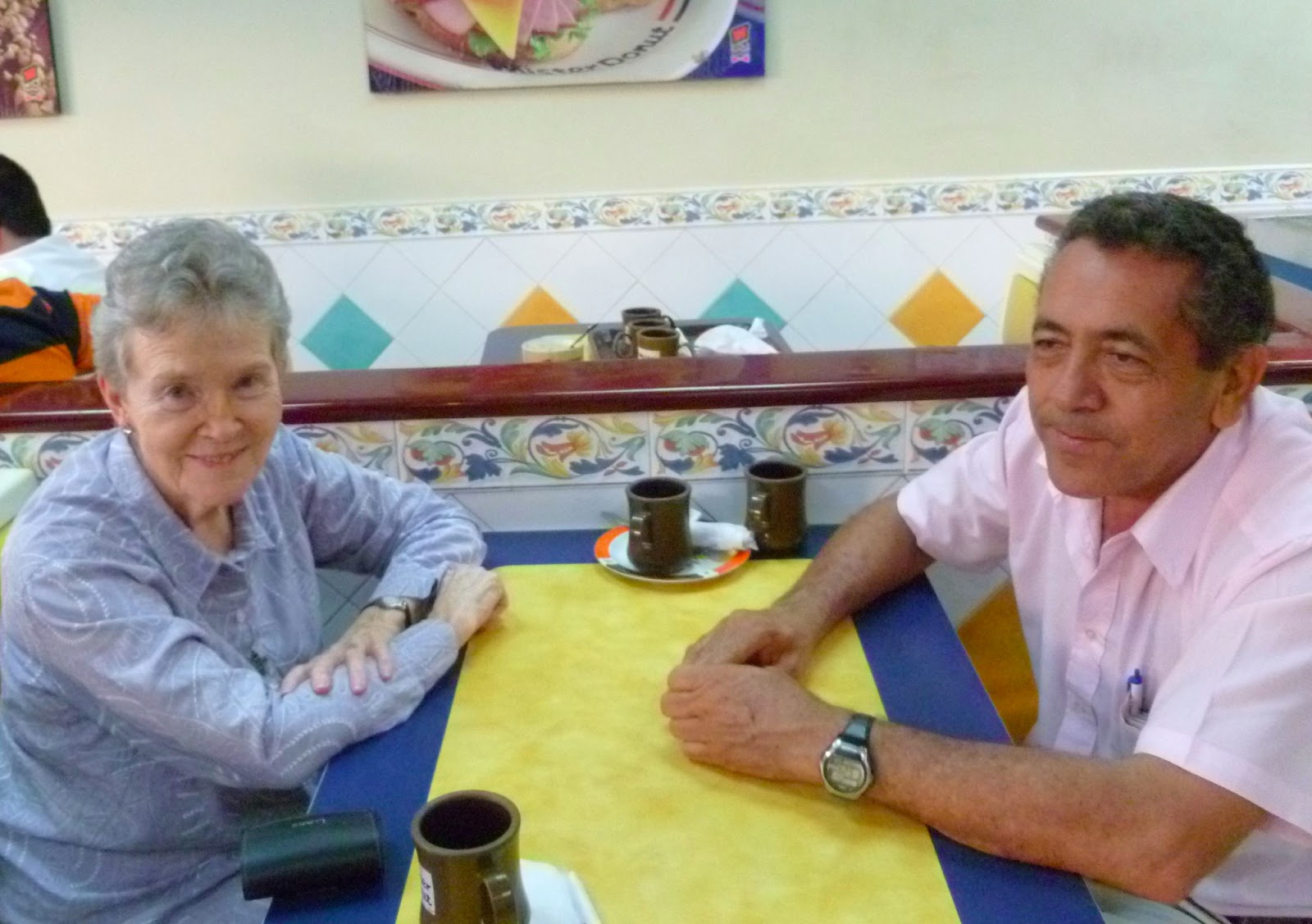
 And she went on to a happy reunion in Mr. Donut - always a favorite connecting place - with Lolo Guardado, who has long been helping groups of artesans to sell their work -
And with Hernan Merino, the motorista who keeps us all safe and very happy during many mission trips:
Even here in Suchitoto, Eleanor has had some wonderful days with Peggy O'Neill, and yesterday Moises Alcides Garcia came by.  This 20-year-old is about to graduate from a 2 1/2 year Tecnico program in graphic design in the Universidad Andres Bello, and he brought his portfolio to show us the work he's done.  Eleanor was remembering eight years ago, when a frail 12-year-old Moises needed two new heart valves and PeaceHealth's Roland Trenouth made sure the replacement valves were purchased so Moises could have his surgery in Hospital Bloom.  What great changes in the life and prospects of Moises Alcides!
It's been a grand time, full of memories and hope.  Thanks, Eleanor, for sharing this time with me, and for all the many years you have joyfully shared with the people of El Salvador. 


Monday, November 19, 2012

Exploring the ruins

A delightful excursion yesterday - the Burgos family invited me to go with them to Tazumal, the largest and grandest of El Salvador's Mayan ruins.  We were joined by Jennifer, a norteamericana newly in El Salvador who teaches English subjects to Camila Burgos and her classmates in a bilingual school. 

Seeing Tazumal and listening to our very knowledgeable guide (above), I was reminded how recent we people of European stock and tradition are in this land's long history.  Tazumal and its surroundings have been continuously inhabited since about (hope I'm remembering this correctly) 1000 B.C.E., and the area is full of unexcavated remains from those earlier days.  Here's the main temple:

That earlier world still survives in many ways - in customs, in agricultural practices, in foods, in ceremonies, in family traditions - though in El Salvador it's been pretty thoroughly "translated" and blended into Latin-American life.  And, of course, that world survives in the people, especially in the campo: even though very few any longer speak Nahuat or Lenca, they carry the history in blood and bone. 

We finished our visit as those ancestors might have, walking across the street for lunch at a restaurant serving yucca, the premier dish of Chalchuapa, where Tazumal is located.   Yucca salchichada con chicharón and yucca frita con curtido - boiled yucca (tastes like the best potato you can imagine, only better) with pork rinds, and fried yucca with vinegar slaw - delicious.  Gracias a los Burgos for a wonderful day.

Tuesday, October 9, 2012

Elemental struggles

I'm back from London, where every street was rich with history, with elaborate architectural detail, with an immense variety of people from all parts of our world.  Thanks to our Sisters of St. Joseph of Peace Congregation Programme, we were able to see beyond that beauty and visible wealth to the struggles of those who are just trying to survive, trying to get a foot in the door, or losing their petition for asylum. 

Now I'm back in El Salvador where history is briefer and more ambiguous,where there's less variety of peoples, but where the struggle to survive is often sharper and more challenging.

The problems my Salvadoran friends have to confront and survive make me sad and humble.  One of my friends called to tell me his brother had been arrested, accused of a murder that happened two years ago.  My friend thinks he can prove his brother was at work at the day and hour of the murder, but he has to find money for a lawyer to put those proofs before the court, and his family is poor.

Another friend stopped by with her 18-year-old daughter, who is scheduled for kidney surgery tomorrow.  She's been taking care of her daughter and her father, who has a failing heart.  She makes her family's living by doing laundry, and she's looking pretty desperate right now.

I can help a little, thanks to Sisters and Associates who have generously given money that I save for the needs of people here in Suchitoto, but it's very limited help, and the needs are huge.  I'm painfully aware of the gap between the rich world - in London asylum seekers who were admitted could also get housing and some income support - and the poor world, where the struggle just to put food on the table can be overwhelming. 

Friday, August 31, 2012

Chepe y Chui y Chincha y Chita y Chana

I love nicknames here.  To my (gringa) ear they have even less relation to the original name than is usual in English.  For example: the nickname for José is Chepe (or Chepito); Jesus is Chui (sounds to the gringa like Chewy); Geovany is Chincha; Felicita is Chita, and I was delighted to learn that Susana is Chana.  You'd notice a preference for the "ch" sound - and somehow that makes sense to me, all those "ch" names sound friendly.  Of course there are nicknames like Rosy and Mari, and if some of the popular English-sounding names, like Marvin and Nelson and Wilson have standard nicknames, I haven't heard them yet.   I'm tempted to try Charvin or Chelson, but that's probably wishful thinking. 

Sunday, August 26, 2012

Bienvenidas

I was alone in this huge house for a short time after Margaret Jane returned to New Jersey, and I felt like a small marble in a very big box, just rattling around.  Peggy O'Neill introduced me to Maria del Carmen, who wanted to move to Suchitoto and was looking for a place to stay, and I am so glad that she's moved in.  Here she is in the patio, in the shade of the lemon tree:


A Salvadoran, Maria del Carmen was once a Hermanita de Jesus de Carlos de Foucauld (Little Sister of Jesus of Charles de Foucauld), has been a peacemaker and community organizer in Chalatenango, and supports herself by creating beautiful cards with dried flowers and leaves.  She's my new Spanish teacher - and it makes a great difference to be speaking Spanish at home.  She'll also be volunteering with children at the Centro Arte para la Paz.  And she has amazing stories to share. 

We're going to be joined tomorrow by Melinda from the University of Santa Clara, an artist who's also volunteering at the Centro Arte para la Paz over the next couple of months and who will live here.  Happily she speaks Spanish - I understand her parents are from Mexico - so that will be the language of the house.

Que alegría, what happiness, to share the house with Maria del Carmen and (prospectively) Melinda, to create a new community in this beautiful space.

Sunday, April 15, 2012

The leaf player

Patti and I had an amazing meeting yesterday.  We were visiting Santa Ana to see the grand neo-Gothic Cathedral and the other handsome buildings - theater and city hall - surrounding the parque central.  Seemed the cathedral wasn't going to be open for another half hour, so we sat in the parque, enjoying the people and the trees.  Along came this señor, clearly a Barcelona fan, who began to make some pretty amazing sounds with the aid of nothing more than a single leaf that he held in his mouth and breath and no doubt some years of practice.  Sounded a bit like a soprano saxophone, said Patti, and he was definitely tuneful.  Sadly my iPod Touch needed recharging or I might have tried to capture the sound. 

A few minutes later the doors of the cathedral opened and we all went in to pray (and in our case, to look about as well).  Our leaf player went in too, to say the rosary.  There's one man who knows how to make a joyful sound to the Lord!  Alleluia!

Friday, April 13, 2012

Signs of stress and distress

I get a Google alert on El Salvador each day - basically an updated clipping service, with links to news items in English that mention El Salvador.  Usually it's mainly soccer news and stories about Salvadoran immigrants living in the U.S.   Today's alert, though, led to two startling and disquieting stories.  First, a story in Gallup.com reported a poll of how people in countries all across the world rated their lives.  Participants were asked to rate their current lives and what they thought their lives would be like five years from now on a scale from 1 to 10, with 10 being the best life that person could imagine.  Those who rated their current lives and prospective lives at 4 or below were classified as "suffering": the other possibilities were "thriving" and "struggling."  I was shocked to learn that El Salvador followed Bulgaria, Yemen and Armenia as the country with the 4th highest level of "suffering" with 33% of the respondents reporting that level of pessimism.  What was even more surprising was that the other Central America countries, where violence, impunity, and lack of opportunity are just as strong, registered much lower levels of "suffering," and that no other Central American country was among the 20 with the highest level of suffering.

On the other hand, El Salvador, Guatemala and Honduras all registered steep increases in the level of suffering over the past year - in Salvador, 24% more responded as suffering than a year ago.  That makes more sense: the drug trafficking and gang violence that has struck all three countries in Central America, the level of murder, extortion, and unchecked criminal activity coupled with lack of trust of the police and judicial systems, means that people live with constant fear, stress and uncertainty about their own most basic safety.

That was the other disquieting article in today's clutch of stories: an article by Hannah Stone in In Sight - Organized Crime in the Americas about El Salvador's failure to move on police reform.  While the murder rate has dropped significantly since a gang truce that was apparently mediated by the Catholic Church, the government has taken no significant steps to really reform or police the police.  I know from my Salvadoran friends that many do not trust the police, that they will not take extorsion attempts to the police, and that they believe many police are allied with the gangs.  As the In Sight article details, police members have been credibly accused of beating people up, torture and even murder.  I also know some policemen and women who are good and decent people.  They deserve, as do all Salvadorans, a real effort to curb violence and intimidation.  And then hope could grow.

Tuesday, April 10, 2012

Living in a village

One of the very good things about living in a village - well, really a small town - is that it's pretty clear who can do what.  Need an electrician, un electrista?  Felix would be your man.  For minor plumbing problems and any other small things that crop up, Alcides can handle it.  Chamba is the guy to call for car trouble.  And when the refrigerator goes on the blink, as ours did, quite predictably, on Good Friday?  It's time to call the other Chamba, Martha's cousin Chamba Rivera.  Here he is, at work (and as you can see by his striped shirt, he is a Barçelona football fan, like just about every other Salvadoran):

He spent about two hours, repaired the motor driving the fan that sends cold air down to the refrigerator from the freezer, cleaned out the refrigerator from top to bottom, and charged us all of $25.  Priceless!  The ice cream and roast for Sunday even stayed frozen in our ice chest. 

And, as a special bonus, I learned that Chamba is a nickname for Salvador - go figure!  I have no idea how anyone gets to Chamba from Salvador, but I'm glad to know the connection.  Nicknames here are often surprising to the anglo ear, like Chepe from José or Chui (Chewy) from Jesús.  But then Chuck from Charles or Jack from John aren't so obvious either. 

I'm just glad that Chamba, Señor Salvador Rivera, is so very good at his work, and glad to live in a village where it's easy to find out just who to call for any likely disaster.

Wednesday, March 28, 2012

A Success Story

Last fall we gave a beca - a scholarship - to Iris Hernandez, daughter of Gumersindo Hernandez, who had been one of our major volunteers in San Juan Opico.  A few days ago Iris called me to say that she needed to meet with me.  We set up a time and place, and I began to think of all the things that could have gone wrong - illness, trouble in school, family problems, etc.

But when we connected Iris was there with her Papi, Gumersindo, to give me the best news - she has just been chosen for a U.S. AID scholarship to study business psychology in Minneapolis, Minnesota for two years.  She was beaming with excitement and delight and Gumersindo, a quiet man, was visibly proud.  Iris is shy about speaking English now, and I imagine she will start off in an intensive class (her scholarship begins in August) and - since she's a very bright and joyful person - will soon be chatting happily.  May these two years be a blessing for her and for her family!

Monday, March 5, 2012

An El Salvador light on the scriptures

Yesterday I was invited by my Seattle parish, St. Patrick's, to reflect on the readings for the 2nd Sunday in Lent in light of my experience in El Salvador.  The readings were the sacrifice of Isaac (Genesis 22, 1-18); the passage from Romans that asks "if God is for us, who can be against us"; and the Transfiguration (Mark 9, 2-10).  Here's what I said:


God put Abraham to the test.  How can we bear to hear this passage from Genesis, this terrible story of child sacrifice required by God?  We can look at it from a distance and say that yes, it’s a story about leaving behind an ancient and horrible tradition of sacrificing the first born son, leaving behind the image of a God who would require that sacrifice.  But we’re still faced with the unimaginable horror of that moment when Abraham turns to bind his son and lay him on the altar in his obedience to a bloodthirsty God.

But at that awful moment on the mountaintop there’s a pause, then a shift,  the light changes and the angel says NO, no, put down that sword, here is your beloved son, here is your future.  Who could bear such a moment? 

We are all put to the test in our lives, facing questions of who we are and who we’re called to be, facing into grief and loss, or finding ourselves in a moment when what’s asked of us – going with someone we love through a terrible crisis or caring for someone we love who is dying – seems far beyond our power to give.  This happens often enough to those of us who live in the rich world of North America, but how much more often are our brothers and sisters in the poor world, in countries like Haiti, Somalia, El Salvador faced with tests that you would think no one could pass

Many of you know that I have been living in El Salvador for three years now, coordinating PeaceHealth’s medical mission program and getting to know the people and the tragic history of this small Central American country.  El Salvador means “the savior,” of course, “el Salvador del mundo,” the Savior of the World.  And the feast of the Savior of the World is the feast of the Transfiguration, an event celebrated with a week of vacations and celebrations and processions every August.  …So as I reflected on today’s readings I began to ask myself what my Salvadoran friends and neighbors will be making of them.

They won’t, I think, find the sacrifice of Isaac as strange, as horrifying, as archaic as we do.  It’s going to remind them too clearly of the realities of their history and of their lives – and of the way their lives are part of God’s story.  It will remind my friend Lita of watching from a refugee camp in Honduras as villagers fleeing Chalatenango were mowed down by Salvadoran and Honduran troops.  It will remind Doña Licha of the nights she spent huddled hungry and terrified with her children in what’s now our pleasant little tourist town, Suchitoto, listening to rockets and bombs and gunfire.  It will remind Doña Mercedes of the day she found the headless body of her son in a Suchitoto park. It will remind Doña Tulia of San Antonio Los Ranchos that she lost nine of her eleven children during the Civil War. 

Rogelio will remember, as he does every day of his life, that he witnessed the massacre of his family and his village, Copapayo, escaping only because he – a 10-year-old boy - fell back among high grasses and played dead. 

it will remind them all of the story of their beloved pastor, prophet and martyr, Monseñor Oscar Romero, who knew he was marked for death in 1980 and asked only that his blood become a seed of liberty for his people.

The sacrifice of Isaac might also remind my Salvadoran friends of the terrible choices and realities they often face in the present moment: to know that your child’s life could be saved with a new heart valve that you cannot possibly afford; to love and raise children who may well grow up and join a gang; to pay protection money to the gang so you can keep your little store open; to save money so you can send a family member north for the hope of remittances. 

But in their terrible experiences – in the past of the civil war, in the present of poverty and violence and limitation – they know God who stands with them, God who is for them.  “If God is for us, who can be against us?” asks Paul.  This is not the God who demands sacrifice, but the God who loves and saves – the God of the Transfiguration, who saves Isaac, who loves and reveals Jesus, who leads us up the mountaintop to the place where truth can be known. 

The God revealed to us all in the Transfiguration is not a God who saves us by keeping us from suffering.  Just before this passage in Mark’s Gospel Jesus says, “whoever wishes to save her life will lose it, but whoever loses his life for my sake and that of the gospel will save it.” And coming down the mountain, he reminds them that the story leads to resurrection – but only through death.  Still the disciples are allowed to see what my Salvadoran friends know in their hearts and souls: here is the Beloved.  Through Jesus we are all the Beloved.

I find it hopeful that Peter, the Rock on whom our church is built, is such a bumbler.  He’s been taken up to the mountaintop with James and John and he sees the reality revealed, the dazzling white clothes, the conversation with Moses and Elijah (and what would be the sound of that conversation – birdsong, falling water, fire?) and he’s terrified – they are all terrified – at this fearful reality.  Peter, it seems, can’t just fall on the ground in silence before this Jesus, he has to do something – let’s keep this going, let’s make some tents, let’s have a party, he says. 

But then they are overshadowed, Peter and all, by the truth within the truth: “This is my beloved son.  Listen to him.”  And suddenly there’s nothing to be seen anymore but Jesus alone with them, the truth within the truth on the mountaintop. 

I believe that’s the Jesús my Salvadoran friends know, the beloved one, the one who loves them even though AND BECAUSE they’re bumblers too, as are we all, who loves them even though AND BECAUSE their lives are lived at the margins of the world’s great events, who loves them even though AND BECAUSE, like the disciples, they don’t understand theology and don’t know how to make a liturgically correct response to the Transfiguration.

Instead, like Peter, they make a party, a fiesta.  No one makes fiesta like my neighbors in El Salvador, with costumes and firecrackers and processions and speeches and dances and food and drink.  They celebrate being alive, even though it’s hard, this life.  They celebrate the truth within the truth, that they are seen and known and loved, just as they are.

My friend Lita – the woman who witnessed the massacre at the Rio Sumpul - comes to visit Margaret Jane and me most Thursdays.  Lita got to know our Sisters Andrea and Margaret Jane when she lived in the Calle Real refugee camp during the civil war and they were providing some safety by being an international presence.  Now she’s a health promoter, a pillar of life in her El Bario community, a woman who, given half a chance, could manage the world.  When she comes to call we have lemonade and cookies and talk about her disabled granddaughter, about the trouble she’s been having for months with a sinus infection, about the hard work. 

La vida no es facil, she says, life isn’t easy, la vida no es facil.  And then she laughs and lets down her beautiful long hair, black streaked with white, and she gives us a great hug and maybe some mangoes or tamales and says “Primero Dios nos vemos el otro jueves” – God first, we’ll see each other next Thursday.  Primero Dios, God first: that’s what Lita and my Salvadoran neighbors get right, what we gringos often get wrong.  We want to think it depends on us whether we’ll meet on Thursday.  Lita knows that our meeting, everything, depends on God.  And then we laugh together because we know that la vida no es facil, but it is transfigured by love and laughter, by the truth within the truth and, primero Dios, we will meet.

Friday, January 6, 2012

Feliz Año and all that jazz

It's a bit of a shock to find I haven't posted since New Year's Eve.  But mind you, the silence has only been on the blog channel.  Andrea and Judith and I have been having a wonderful time, first in Antigua, and then in El Salvador, where we visited our February medical mission site in San José Villanueva and last year's site, San Rafael Cedros.  There we had lunch with Mari and her family and enjoyed Richard Stanley looking healthy and happy with his new heart valve working just as it should - and Judith got to see one of our water filters in use.  This was especially nice, because she's donated quite a few of them to PazSalud.

But yesterday was the best, though not at all what we had planned.  We had planned going to visit Nuestros Pequeños Hermanos, a home for orphaned and abandoned children that's north of Santa Ana, a fairly long drive from Suchitoto.  We set out, and five minutes later the car announced that it was shutting down - check engine light on, engine coughing, and - we quickly discovered - the temperature up at the ceiling.  We called Peggy, who sent out her friend and car doctor Chamba; Chamba arrived in a pickup, put some water in the radiator which promptly began dripping out again which led to a diagnosis.  He refilled the radiator and drove the X-Trail back into a taller (repair shop) in Suchi, and we followed behind in his pickup, driven by a young friend.  Riding in the back of the pickup was a great treat for Judith, after she'd seen so many Salvadorans in one. 

There we were at home when Peggy called to say she had a special friend of Andrea's who'd just popped in for a visit.  She sent him over, and it was the famous John Guiliano, who'd worked as a volunteer at Calle Real with Andrea and Margaret Jane during the Civil War, decided to stay in El Salvador, married, settled in Guajila, Chalatenango, and is working to engage the young folk of that community in sports.  I'd heard so much about him, and he lived up to billing: joyful, dramatic, very Italian, determined and great fun.  We also got to meet his beautiful 15-year-old daughter Rose, and we all went out to lunch at the Café Guazapa and listened to the stories.  Imagine, if the car hadn't had a breakdown, John would have missed seeing Andrea for the first time in about 25 years.

I was glad, too, because the day at home gave me time to assemble all the materials that I needed to present today for our customs approval - there were three separate packets, lots of paper, lots of details to worry about, and I needed the time.  And today, oh joy, I got each packet into the right office with the right people there to receive it.  Primero Dios, we'll get our franquicia in plenty of time this time... And in any case, gracias a Dios for getting to meet John and share a memorable lunch.  Oh, and the car repair was well done, we've driven all day today with no trouble.  Gracias tambien a Chamba.

Sunday, December 4, 2011

Getting around


After almost three years here I'm almost used to the wild and various means of transportation in El Salvador.  Any truck comes with at least two muchachos riding - and often sleeping - on top of the load.  Sometimes the muchachos really have to work, as in the bottom photo of a refrigerator being perilously delivered.  Pickups fill in all the holes in the transportation system, packing in crowds of standing-room-only passengers.  And the buses are many and various, often dangerous - bus drivers and cobradores (the guys who cram yet two more people into overcrowded buses) are often the targets of shootings when the owners of a bus line are late in paying the renta.  Still, they are inescapable, the only way most people here have to get to work or to school or to the doctor. 

I love the names and mottos and icons on our buses.  There's one called "Love and Jope" which doesn't quite work in Spanish or English, but you get the idea.  I recently drove behind a bus that proclaimed in big type, No es culpa mia, it's not my fault.  Decided to pass him quickly before he could live up to the slogan.  And my all-time favorite is a bus with Jesus on the back mirror, in his crown of thorns, like the 2nd photo here.  Underneath a motto: Salí con tu mujer, I went out with your woman.  That reverence and cheeky irreverence, cheerfully combined - muy Salvadoreño.


Sunday, November 27, 2011

Getting to Know You

This Sunday and last Sunday I traveled to San José Villanueva, the site of our February Medical Mission, to meet with the volunteers who will be inviting patients to our mission.  Sunday turns out to be the best meeting time, after the early morning mass.  Today there were about 30 people gathered in a big classroom, lots of questions about the mission and about who should be invited.  If only we could see everyone in the community!  But our limit, we've found out over the years, is about 325 people per day, many of them going to two or more clinics.

Today they did the hard work of deciding which communities would come to the clinic on each day.  This is always the point where it begins to seem real and possible to me, so I rejoiced to watch these community leaders at work.  Already we have enough volunteers signed up to work with us throughout the week, which is amazing at this early point.

We're going to be using one wing of the parish school, which includes the meeting room shown in the photo.  It's great space, with a covered area when patients can wait, separate rooms for each clinic, a good pharmacy space and even a break room.  For all the great space, our work will not be easy; this week a report from the World Food Program shows San José Villanueva as having one of the highest levels of malnutrition in the country among children under five years - an estimated 38% of the youngest children in this rural town are small for their age.  What we can do to help in a week of clinics is really limited; our vitamins will do some good, but don't change the poverty that leads to such hunger among children.  And yet, we will be there as witnesses, and witnessing has value.

Wednesday, October 26, 2011

An Unnatural Disaster

There's a superb post on Tim's El Salvador Blog about the human role in the disastrous rains and floods El Salvador has experienced this month. I don't think I've seen a better analysis of the complex ties between ecological damage and economic violence to the poor.

He quotes a fierce and superb statement by San Salvador Auxiliary Bishop Gregorio Rosa Chavez: the disaster caused by the rains demonstrated "the economic vulnerability, that is to say the poverty so many of our countrymen live immersed within, the social vulnerability, characterized by the structural injustice and the ecological vulnerability, for which the great fault lies in the wild ambition that rages against God's creation, this house of all of us which is deteriorating more each day."

I remember that in the 2008 Chapter of the Sisters of St. Joseph of Peace, we struggled to articulate the connection between climate change and the needs of the poor. Well, here it is, in the suffering of thousands of poor people displaced by rain and floods, an unnatural disaster that hardly touches the lives of the middle and upper classes in El Salvador. As Tim says, there are no photos of flooded mansions, no videos of Land Rovers swirling in the overflowing rivers. The land is "the house of all of us," and only the rich can hide from its devastation.

Monday, October 24, 2011

A letter from Comasagua

I got an e-mail today from Alex Hernandez, a friend and a great volunteer in our 2009 medical mission in Comasagua. Alex writes (and I translate, loosely) -

I want to tell you about the week of rains and the chaos in Comasagua because of the tropical storm. Twelve shelters have been opened for people in our municipality [municipalities in El Salvador include all the smaller communities around a central town] and I have been in one of them, caring for 50 people day and night, watching over the women, children and old people sleeping and making sure they get their three meals in the day. This has been a beautiful experience for me because you know that one becomes fond of the people and I feel a love for them as if they were my family. I don't know if you understand me, Sister Susan, it's something that it's not possible to explain.

I'm also working in the church with our priest, helping to organize the assistance that arrives for the people in shelters, and then sharing it out with them. I can tell you it was good to be helping my neighbors because they needed the help, but at the same time sad to see so much suffering, to see the faces of each of them, far from their lands, their houses lost, their crops ruined, exhausted after days of suffering. I'm glad, though, for all the work we have been able to do for them. Comasagua begins a new life.


I do understand, Alex, and I know that the help you're giving your neighbors, your new family, returns as a blessing to you. I thank God that you and so many others are working all over El Salvador to help the people first to survive, and now to begin to return to their homes and start the long hard work of digging out and starting again.

Sunday, October 16, 2011

Dean Brackley, October 16, 2011


I learned today via an e-mail from Gene Palumbo that Dean Brackley, S.J. - priest, writer, tireless worker for justice, and great friend of the people of El Salvador - died in Santa Tecla today.

Dean has been a great friend to our El Salvador Health Mission as he has been to every peace and justice-based program that connects people from the U.S. with the people of El Salvador. This photo is from Eleanor Gilmore's farewell party in 2009: Eleanor is on Dean's right and Guadalupe Montalvo Palumbo on his left.

I last saw Dean after our eye surgery mission in May of this year; Kathy Garcia and I talked with him while our group was touring the Romero Center at the UCA (University of Central America). He'd been talking to a delegation - one of the hundreds he met with - and came out to talk about getting some medications for the people he worked with in Jayaque. He was thin and worn looking, and told us that he'd had a colonoscopy that morning and was tired. Soon after that, we learned that he'd been diagnosed with pancreatic cancer that had metastasized.

Gene says:
As you know, Dean came to El Salvador to help replace the six Jesuits murdered in 1989. Today, his life as a Jesuit ended in the place where their lives as Jesuits began: the Santa Tecla residence, where they did their two-year novitiate.
and he quotes an e-mail from Dean's brother Jesuit, Rafael de Sivatte:
I write to give you the painful and joyful news that God, Father and Mother, has taken to his side our brother, friend, father, and companion in solidarity, Dean. I can tell you that he died so peacefully that those of us who were with him at that moment felt filled with peace ourselves. I send you a fraternal embrace, united with you in prayer and in the commitment to the Kingdom for which he worked and continues to work.

Tuesday, September 6, 2011

A week in New....

I'm away from El Salvador for a long week - four days in New Jersey for an editor's meeting to plan the next issues of Living Peace, our Sisters of St. Joseph of Peace magazine, followed by four days in New Mexico to visit with my friend Pat D'Andrea and some other dear friends from my 20 years in that state.

Yesterday Corky Muzzy and I crossed under the Hudson on a long bus ride through New Jersey communities and spent Labor Day walking in Central Park - which was gloriously full of New Yorkers of all sizes, ages, and sorts enjoying a grand vacation day. So I'm visiting New Jersey, New York and New Mexico - if only I could get to New Hampshire, I'd have been in all the News. Have to leave that to presidential candidates, I suppose.

On the way to NYC, we passed a number of pupuserias and stores with names like "Sonsonateco." Alicia runs a bakery and pupuseria and a mile or so further on the bus line is the bakery and pupuseria of Las Hijas de Alicia. El Salvador is not so very far away, and Salvadorans are as enterprising - and as fond of pupusas - in New Jersey as at home. Perhaps one of those Salvadorans away from home was the woman who cleans restrooms in the Newark airport, the woman who was singing softly to herself "Pescador de los Hombres," my favorite hymn. It was so grand to hear her that I joined in - even though I have the voice of a crow with laryngitis - and we sang the refrain together happily, and I said "Gracias." And felt at home.

Friday, August 26, 2011

Gloribel hits the books


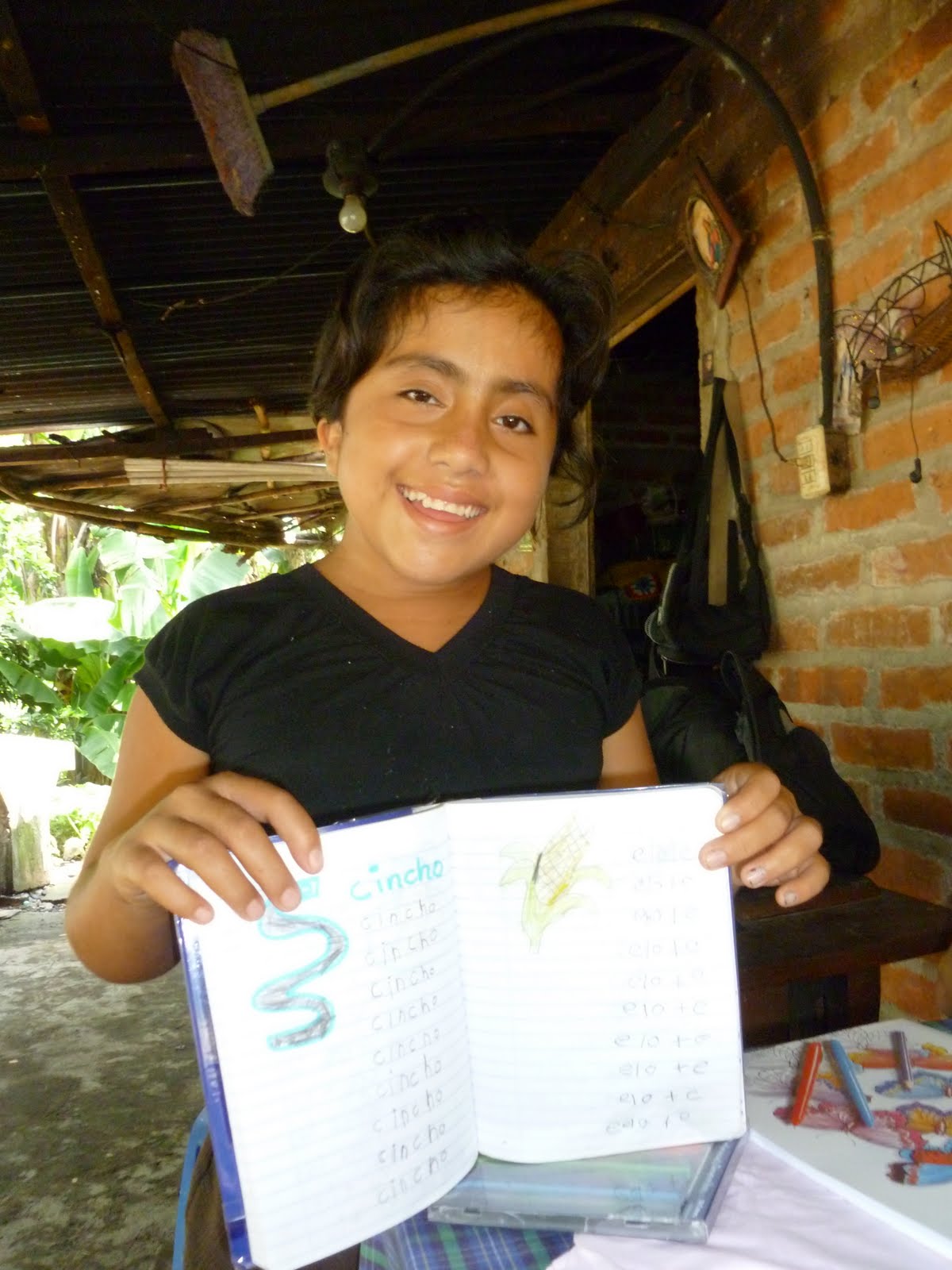
Last week I had a great visit with Gloribel and her mother. Gloribel and her mother Hortensia have been going to a school for deaf children in Santa Ana since March, and they were delighted to show off Gloribel's learning in a heap of carefully written and beautifully illustrated notebooks - one can be seen in this photo. She's been learning a lot of Salvadoran Sign Language as well, and it was great to watch her signing with her mother and sister (and she taught me a few signs, too). Gloribel's intelligence and ability were so clear, even before she got the opportunity to go to school, that it's no surprise that she's blossoming now.

The trip to school, four days a week, demands a lot from both Gloribel and Hortensia - they have to take three different buses to get there, and it takes about 2 hours each way. But Hortensia is glad to give this time, because she is so eager for her daughter to have the learning and skills she'll need to survive as a deaf woman in El Salvador. And Gloribel: she's just glad to be learning, to be communicating, to be in touch with the world.